

AI
How Polsia builds and runs companies with AI agents
Real strategies, frameworks, and insights from leaders who built Europe's fastest-growing products.
14/5/2026
•
.png)
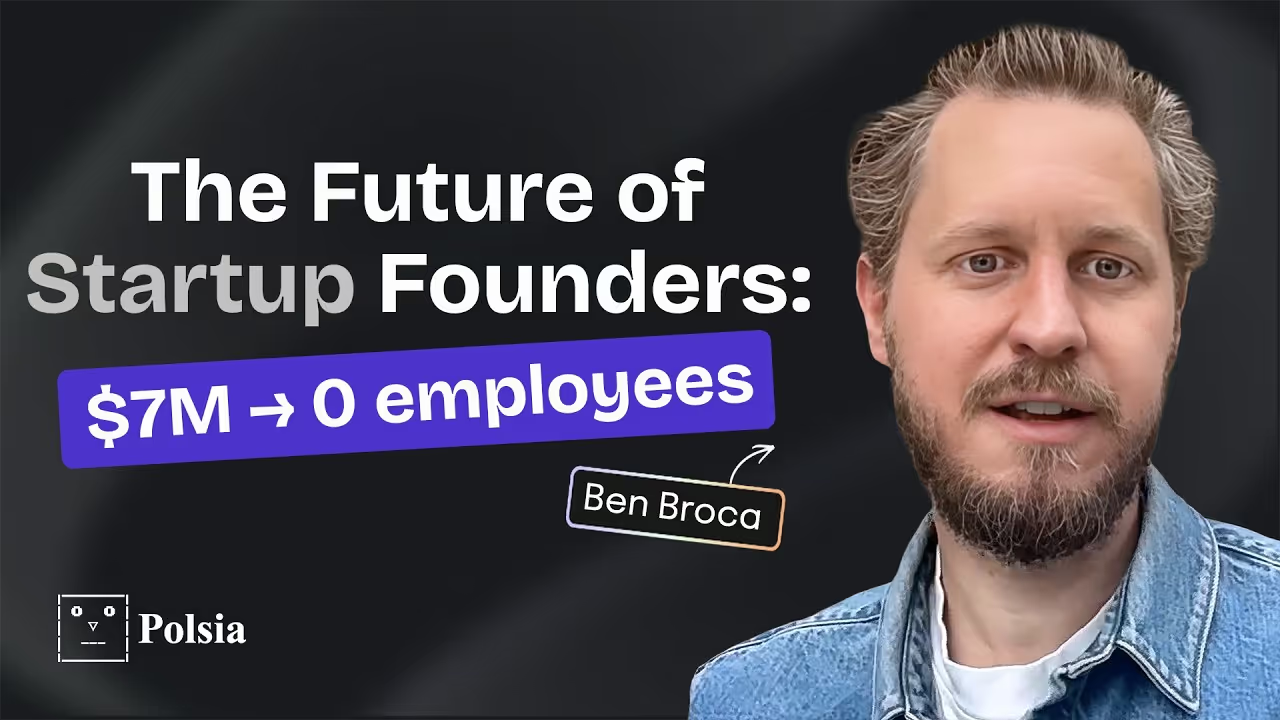
Polsia is one of the most extreme experiments in company building: a startup with zero employees, run by a single founder and a system of AI agents.
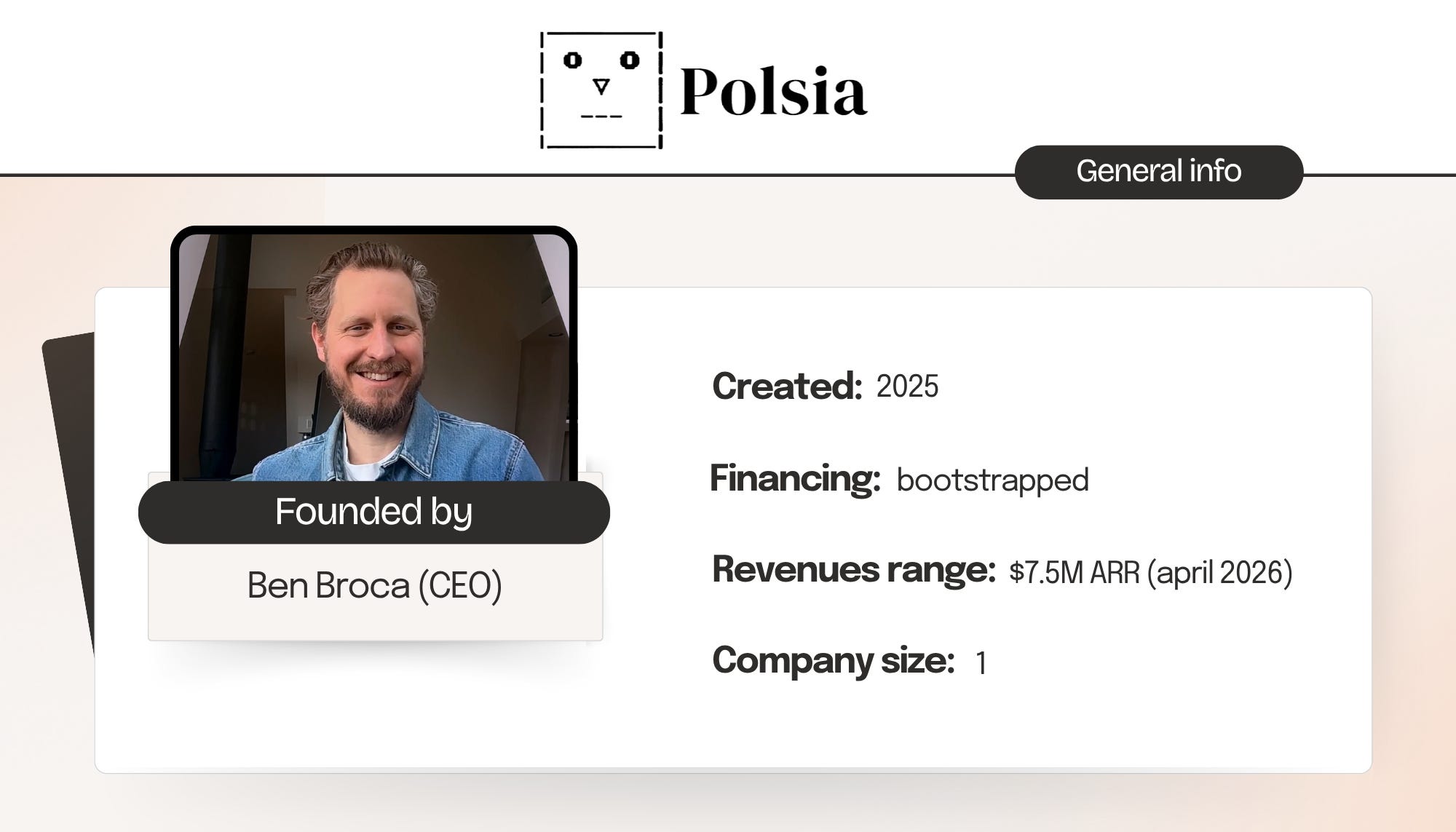
Launched in late 2025 by Ben Broca, Polsia is designed as an AI platform that can build and run entire businesses autonomously. Users input an idea, and the system handles everything: coding, marketing, customer acquisition, support, and iteration.
The early traction has been unusually fast. Within a few months, Polsia reached millions in annual run rate, scaling from early traction to multi-million ARR in a matter of weeks.
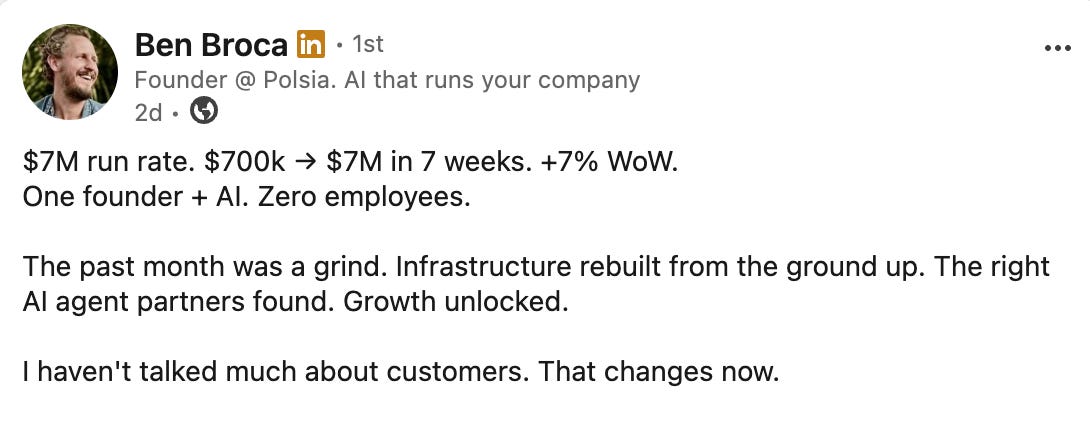
This velocity is partly explained by its positioning: targeting non-technical users who previously could not build businesses, and offering them a fully autonomous system instead of tools they need to operate manually.
Behind the scenes, Polsia is also evolving into something bigger than a product. Ben is building toward a self-sustaining AI-driven economy, where agents, users, and capital interact on a single platform.
I sat down with Ben Broca, founder of Polsia, to discuss how he orchestrates AI agents to run companies, how the 80/20 split between AI and human input works in practice, and what this means for the future of company building.
Disclaimer: The organizational choices and technical solutions shared in this newsletter aren’t meant to be copied and pasted as-is. Always keep your company’s context in mind before adopting something that works elsewhere! 😊
Start with the end state
Most founders would have built Polsia step by step: first a coding tool, then a marketing tool, then orchestration.
Ben did the opposite.
He initially explored separate building blocks, including coding tools and marketing agents. But he quickly realized that assembling components first was slowing him down and fragmenting his focus.
So he made a decisive shift: build the end-state product directly.
He chose to bring everything together into a single system that could already function like a company, rather than refining each component separately. This meant launching with an incomplete product, but one that delivered the core promise from day one.
The key insight here is that integration creates value faster than optimization.
Polsia V1 only had a limited set of capabilities, but they were connected:
- Idea → execution
- Execution → feedback
- Feedback → iteration
That loop was enough to validate the product.
“When I started building Polsia, I was like: let me just go to the end state and build this crazy software. And a month later, it kind of works” - Ben Broca
This approach also unlocked something critical: belief.
Before launch, Ben already knew it would work because the system was able to complete meaningful loops autonomously.
Create systems that operate continuously
Polsia is built around a radical constraint: the system must operate even if the user does nothing.
This is a fundamental departure from most AI tools.
Traditional tools require:
- Prompting
- Iteration
- Continuous human input
Polsia flips that model. Once given a goal, it continues working autonomously, even when the user disengages.
“If you forget about prompting it, it’s going to wake up at night, do work and send you an update in the morning” - Ben Broca
This design decision has major product implications:
- It increases retention through asynchronous engagement
- It creates a sense of progress without effort
- It shifts the user role from operator to supervisor
The daily report becomes a key product mechanic. It re-engages users and reinforces the perception that something is happening even when they are inactive.
This also explains why Polsia resonates with non-technical users. They are not required to learn new workflows or tools. The system behaves more like a collaborator than software.
Orchestrate agents through tasks
At the core of Polsia is a structured multi-agent system.
The architecture organizes responsibilities across multiple layers, each with a distinct role:
- A chat agent that acts as strategist and interface
- A task system that translates decisions into actions
- Specialized agents that execute tasks (engineering, marketing, research, support)
This structure solves two key problems: cost and control.
“The chat agent assigns tasks to different specialized agents, mostly from a cost perspective” - Ben Broca
By constraining agents:
- Each agent has limited tools
- Each task has a defined scope
- Execution becomes predictable and cheaper
This avoids the “runaway agent” problem, where a single agent with full autonomy becomes expensive and inefficient.
Another important layer is memory:
- Company context
- Past decisions
- User personality
This ensures consistency across actions, especially for outward-facing tasks like outreach or content.
Align the system with user success
Polsia’s business model directly shapes how the product behaves.
The platform charges a subscription, but also takes a cut from user revenue. This creates a strong alignment: Polsia benefits when users succeed.
“Polsia is incentivized to make the user work. I want people to make money” - Ben Broca
This alignment influences product decisions:
- The system pushes back on bad ideas
- It prioritizes actions that lead to revenue
- It behaves like a co-founder, not a tool
The chat agent is explicitly instructed to challenge users when needed. This introduces a level of friction that is unusual in software but essential for outcomes.
This also explains why Polsia focuses on non-technical users. It gives them the ability to build and run businesses independently, unlocking capabilities that were previously out of reach.
Build distribution through product narrative
Polsia’s growth combines traditional channels with a strong narrative-driven distribution approach.
Ben designed marketing experiments that demonstrate the product’s capabilities.
One example: letting AI raise funds autonomously.
“I sent to 150 investors an email saying my ‘AI is raising the round’ and it would reply automatically” - Ben Broca
This worked for several reasons:
- It showcased the product in action
- It triggered strong reactions
- It created shareable moments
The product itself becomes the marketing engine.
At the same time, Ben systematically explores multiple growth channels:
- Founder-led content
- Social media
- Ads
- Partnerships
This dual approach combines storytelling with execution.
Turn your product into an economy
Polsia is evolving beyond a SaaS tool into a platform with multiple participants:
- Builders
- Investors
- Buyers of businesses
The long-term vision is a self-sustaining ecosystem where:
- Users create businesses
- Others invest or acquire them
- The system facilitates transactions
This introduces network effects and compounding value.
Ben also plans to:
- Add an investor layer
- Enable buying and selling businesses
- Let the system allocate capital autonomously
This transforms Polsia from a tool into infrastructure.
The mistake: scaling before fixing unit economics
One of the biggest challenges Polsia faced came from its own success.
The product scaled quickly, but the underlying cost structure was not ready.
“I lose money on every customer today” - Ben Broca
The main issue was model cost:
- Expensive AI models
- High usage per user
- Generous support and refunds
At the same time, the product was still an MVP with limited features.
Ben had to pause feature expansion and focus on:
- Infrastructure optimization
- Cost reduction
- Exploring GPU ownership
This highlights a critical tension in AI products: capability vs affordability.
Scaling usage without controlling cost can quickly become unsustainable.

- Build integrated systems early, even if incomplete, to validate real user value instead of isolated components.
- Design products that create value without constant user input to improve retention and engagement.
- Structure agent systems with clear separation between decision-making, task creation, and execution layers.
- Align business models with user success to enable more opinionated and outcome-driven product behavior.
- Use the product itself as a distribution engine through demonstrative and shareable use cases.
- Prioritize cost control early in AI products to avoid scaling unprofitable usage patterns.
- Approach AI as core infrastructure that can take on entire functions within a company.
- Build toward ecosystems when your product enables value exchange between different types of users.
- Use constraints such as staying solo to force more radical and efficient product design decisions.
- Focus on non-technical users as a massive underserved market when building AI-native products.
My full video with Polsia founder
Dive deeper into this topic with Ben Broca, founder of Polsia, in my latest podcast episode:

Test your Product performance in 10 min
Trusted by 100+ startups and top CPOs like:


In this article
About Stellar
Stellar is a team of senior CPOs and CTOs who work hands-on inside product and engineering teams to fix what slows them down. Not advisors. Not trainers. Operators who've done the job before and know exactly where to look.
Discover StellarDive deeper
See all articles
.avif)
.avif)
.avif)