

Product Development
How the best product teams keep shipping fast as they scale
Real strategies, frameworks, and insights from leaders who built Europe's fastest-growing products.
28/5/2026
•
.png)

Every startup moves fast at the beginning. Small teams. Decisions happen in minutes. Products ship in days.
Then scale happens.
Teams multiply. Technical debt accumulates. Coordination costs rise. Leaders become managers. Product discovery slows down.
Suddenly, shipping velocity becomes one of the hardest things to preserve inside the company.
What surprised me while recording the following episodes is that the companies managing to preserve speed at scale rarely do it through heroic execution.
They turn speed into a system.
What changes between early-stage and later-stage companies is not the importance of velocity. It is the way velocity gets protected.
Early-stage founders optimize for momentum and rapid iteration. Later-stage leaders build operating systems that allow dozens or hundreds of people to keep moving quickly without collapsing under complexity.
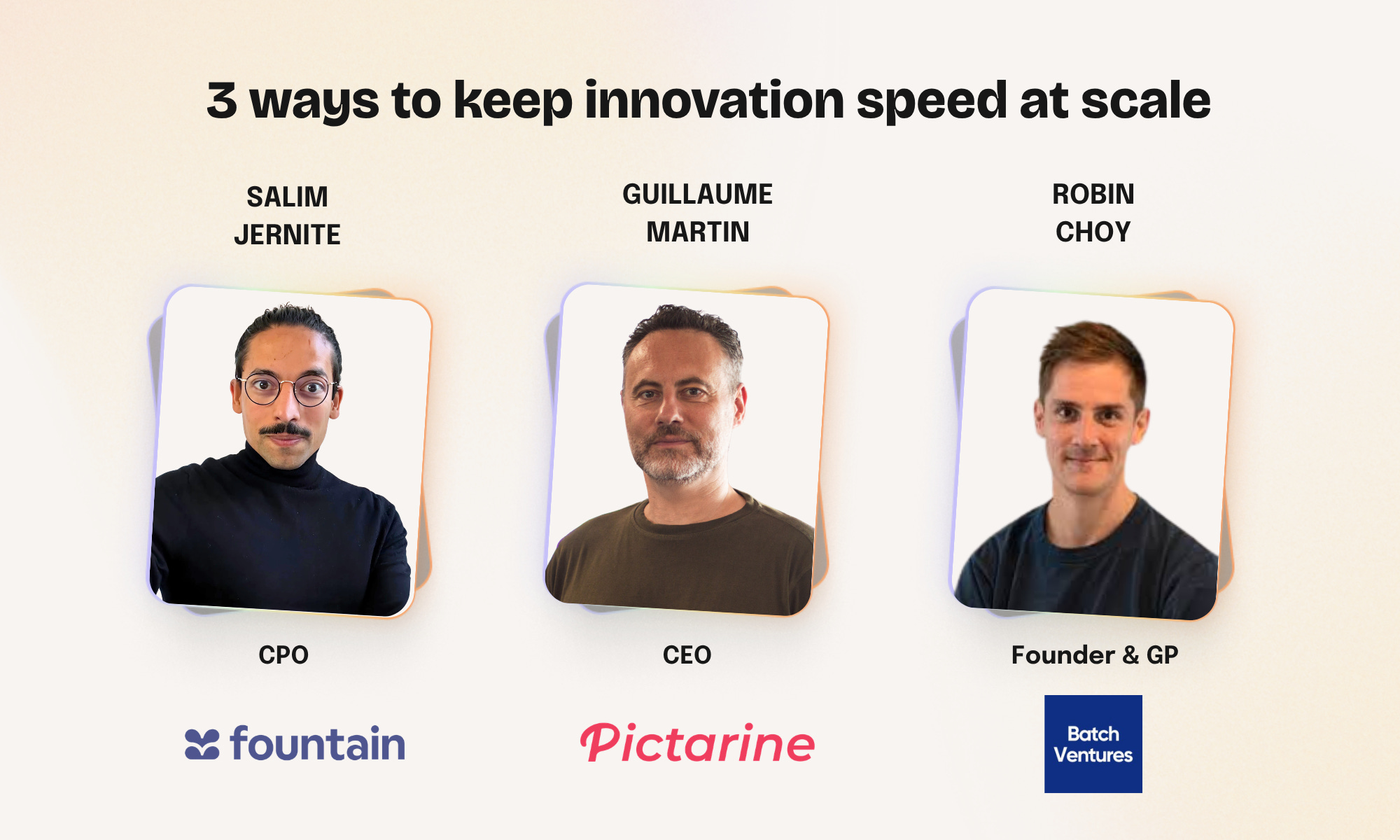
I sat down with Robin Choy (Founder and GP at Batch ventures), Salim Jernite (CPO at Fountain) and François Goldgewicht (COO at Pictarine) to discuss the systems, mindsets, and playbooks they use to keep innovation speed alive from early-stage chaos to scale-up complexity.
Disclaimer: The organizational choices and technical solutions shared in this newsletter aren’t meant to be copied and pasted as-is. Always keep your company’s context in mind before adopting something that works elsewhere! 😊
Speed becomes intentional as companies scale
In the early days of a startup, speed mostly comes from simplicity. There are fewer stakeholders involved, fewer dependencies between teams, and very little process slowing execution down. Product teams can focus almost entirely on building, learning, and iterating.
As companies scale, that dynamic changes quickly.
New layers of coordination appear naturally. Teams specialize. Processes are introduced to reduce mistakes and create consistency. Over time, organizations often become slower without realizing it.
At Pictarine, François built an internal framework called “Radical Performance” around three dimensions: velocity, quality, and impact. Interestingly, velocity comes first.
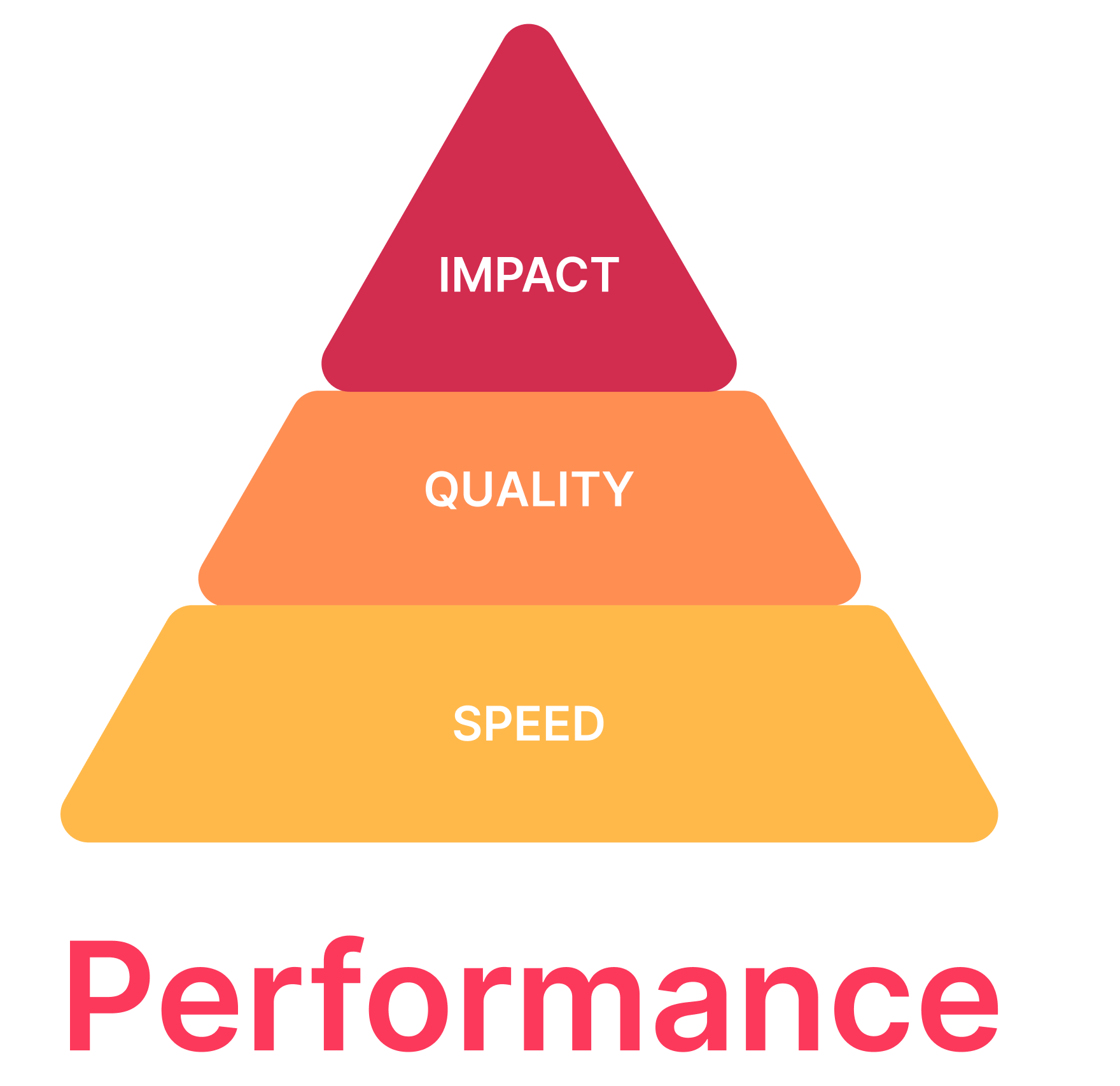
That choice reflects a very specific belief: in fast-moving markets, the companies learning fastest usually win.
The objective is to shorten feedback loops while maintaining high standards and strong strategic alignment.
François explained that many organizations slowly confuse performance with caution. Teams become more defensive, spend more time validating decisions, and gradually lose their ability to learn quickly from the market.
That shift changes the role of product leadership entirely. The best product teams stop asking: “How do we avoid mistakes?” and start asking: “How do we learn faster than everyone else?”
“Performance is velocity, quality, and impact” - François Goldgewicht
Friction becomes the real enemy of innovation
Most companies assume scale is what kills speed.
In reality, friction is usually the real problem.
As organizations grow, friction accumulates everywhere: in meetings, approvals, dependencies, technical debt, and unclear ownership. None of these issues seem dramatic individually, but together they slowly reduce execution speed across the company.
Salim experienced this firsthand after joining Fountain following the acquisition of Clevy.
He expected to discover a highly optimized SaaS machine. Instead, he found teams struggling inside a massive monolithic architecture where every product change created cascading complexity across the organization. Shipping became painful. Engineers spent more time protecting the existing system than building new products.
One sentence captured the situation perfectly:
“The CTO kept saying: I can’t ship new products because there’s too much technical debt” - Salim Jernite
This is one of the most important scaling lessons for product teams. Velocity is rarely lost overnight. It disappears gradually through accumulated friction.
The best organizations fight that aggressively. They simplify communication flows, reduce dependencies, clarify ownership, and remove unnecessary coordination layers before they become systemic bottlenecks.
Robin described a similar philosophy while explaining how Batch Ventures operates. His investment model was intentionally designed to preserve speed through lightweight processes and extremely fast decisions.
The principle applies far beyond investing.
Fast organizations protect momentum relentlessly because once friction compounds, recovering execution speed becomes incredibly difficult.
Alignment becomes a multiplier for execution speed
Fast execution alone is not enough. Teams can ship constantly while creating very little strategic impact.
Pictarine discovered this during one of its scaling phases. Teams were shipping quickly and maintaining strong quality, but priorities had become less connected to the company’s biggest strategic objectives.
That realization led François Goldgewicht to add “impact” as a core dimension of performance. Because without alignment, velocity eventually turns into noise.
This challenge becomes significantly harder as organizations grow. More teams naturally create more initiatives, more tradeoffs, and more competing priorities. Without strong strategic clarity, teams start optimizing locally instead of collectively.
The best product leaders therefore spend enormous energy clarifying what matters most, why it matters, and where the company is heading.
That clarity creates autonomy. And autonomy preserves speed.
At Fountain, Salim had to help evolve the organization from isolated product initiatives toward a much more scalable operating model capable of launching multiple products simultaneously.
The strongest product organizations create systems where teams can move independently without constantly relying on synchronization meetings or executive arbitration.
That is often the hidden difference between companies that scale operationally and companies that simply become larger.
Fast teams make experimentation feel safe
One of the biggest misconceptions about high-performing organizations is that speed comes from pressure. These conversations suggested almost the opposite. Fast organizations create environments where experimentation feels safe enough to happen continuously.
At Pictarine, François explicitly describes well-being and performance as mutually reinforcing. That matters because fear slows organizations down dramatically.
When teams fear mistakes, they hesitate more, escalate decisions upward, avoid risky ideas, and spend too much time seeking certainty before shipping.
Execution becomes slower with every additional layer of caution.
Robin Choy described how the best early-stage environments naturally preserve experimentation because decision-making remains lightweight and fast. Teams can move quickly, test ideas rapidly, and learn continuously without heavy coordination overhead.
That dynamic becomes harder to maintain as companies scale because larger organizations naturally become more risk-averse over time. The best product leaders actively fight that tendency.
Because innovation speed depends just as much on psychology and culture as it does on process or structure.
The hardest part of scaling is rebuilding what once worked
Every successful company eventually faces the same paradox: the systems that created growth start slowing future growth down.
This happens everywhere:
- architecture,
- planning systems,
- org structures,
- product processes,
- and management habits.
The difficult part is that those systems usually worked extremely well previously. That is exactly why companies keep them for too long.
At Fountain, Salim inherited teams slowed down by legacy architecture and organizational complexity.
At Pictarine, François saw that raw startup execution eventually required stronger operational principles to remain sustainable at scale.
The common pattern is remarkably consistent. Scaling companies must continuously redesign themselves. The organizations that preserve innovation speed are usually the ones willing to rebuild before the market forces them to. Because at scale, preserving speed requires deliberate organizational choices around structure, processes, and decision-making.

- Early-stage speed comes naturally. Later-stage speed requires deliberate organizational design.
- The best product teams optimize for learning speed more than shipping speed alone.
- Organizational friction compounds slowly, then suddenly.
- Technical debt eventually becomes an innovation problem.
- Fear and excessive caution slow product organizations dramatically over time.
- Fast teams normalize experimentation and imperfect early versions.
- Companies lose innovation speed when they protect old systems for too long.
- Preserving speed at scale requires continuously redesigning how the organization operates.
- The best scale-ups protect momentum as carefully as they protect product quality.
-
My full video with these product leaders
Dive deeper into this topic with with Salim Jernite, Robin Choy and François Goldgewicht in my latest podcast episode:

Test your Product performance in 10 min
Trusted by 100+ startups and top CPOs like:


In this article
About Stellar
Stellar is a team of senior CPOs and CTOs who work hands-on inside product and engineering teams to fix what slows them down. Not advisors. Not trainers. Operators who've done the job before and know exactly where to look.
Discover StellarDive deeper
See all articles
.avif)

.avif)