

AI
Inside Attention’s path to a multi-product AI suite redefining sales automation
Real strategies, frameworks, and insights from leaders who built Europe's fastest-growing products.
19/3/2026
•
.png)
.avif)
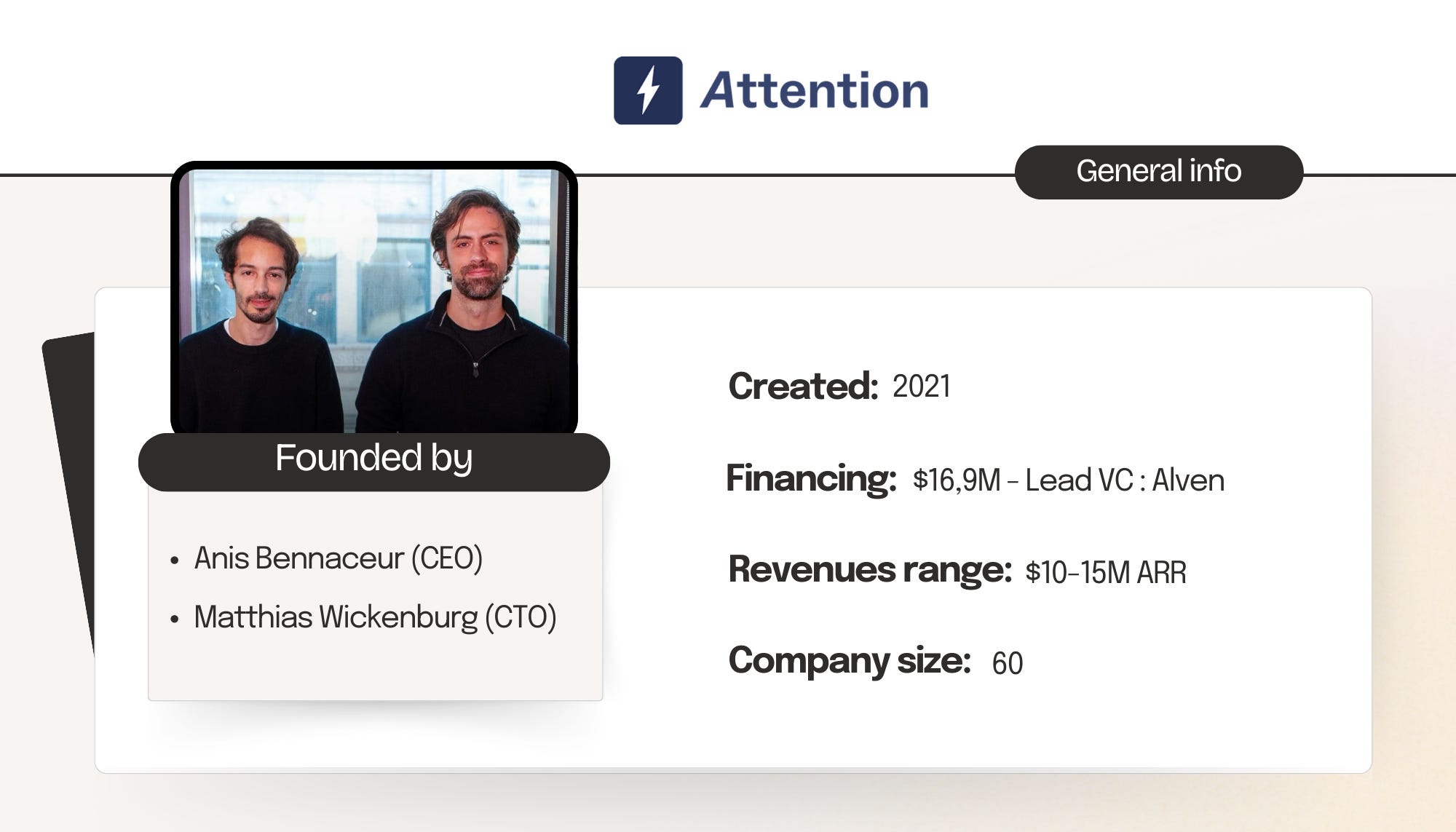
Attention was founded in 2021 by Anis Bennaceur and his cofounder Mathias Wickenburg, with the mission to give every revenue team exceptional clarity by transforming all customer interactions into structured intelligence and action.
Growth data
- Went from 0 to 1M ARR in 10 months.
- Initial pricing $80 per user per month, scaled up to $200.
- 60-person team, including 30 to 35 engineers.
- Product team of 3 people (Matthias, Anis and Olivia).
- 210% Net Retention Rate.
- 120K dollars AC
- Profitable customers spend more than 20K dollars per year.
- ACV x15 in 2 years.
Market & position
Attention positions itself as an AI-powered sales automation platform for B2B revenue organizations. The initial wedge was CRM autofill through LLM-powered transcript processing. As competitors emerged, the company expanded into multi-product intelligence and now agentic workflows. Attention differentiates by shipping new product lines fast, using its own sales team as internal power users, and serving high-growth AI companies that push the product forward. High expansion revenue (210 percent NRR) anchors the business model.
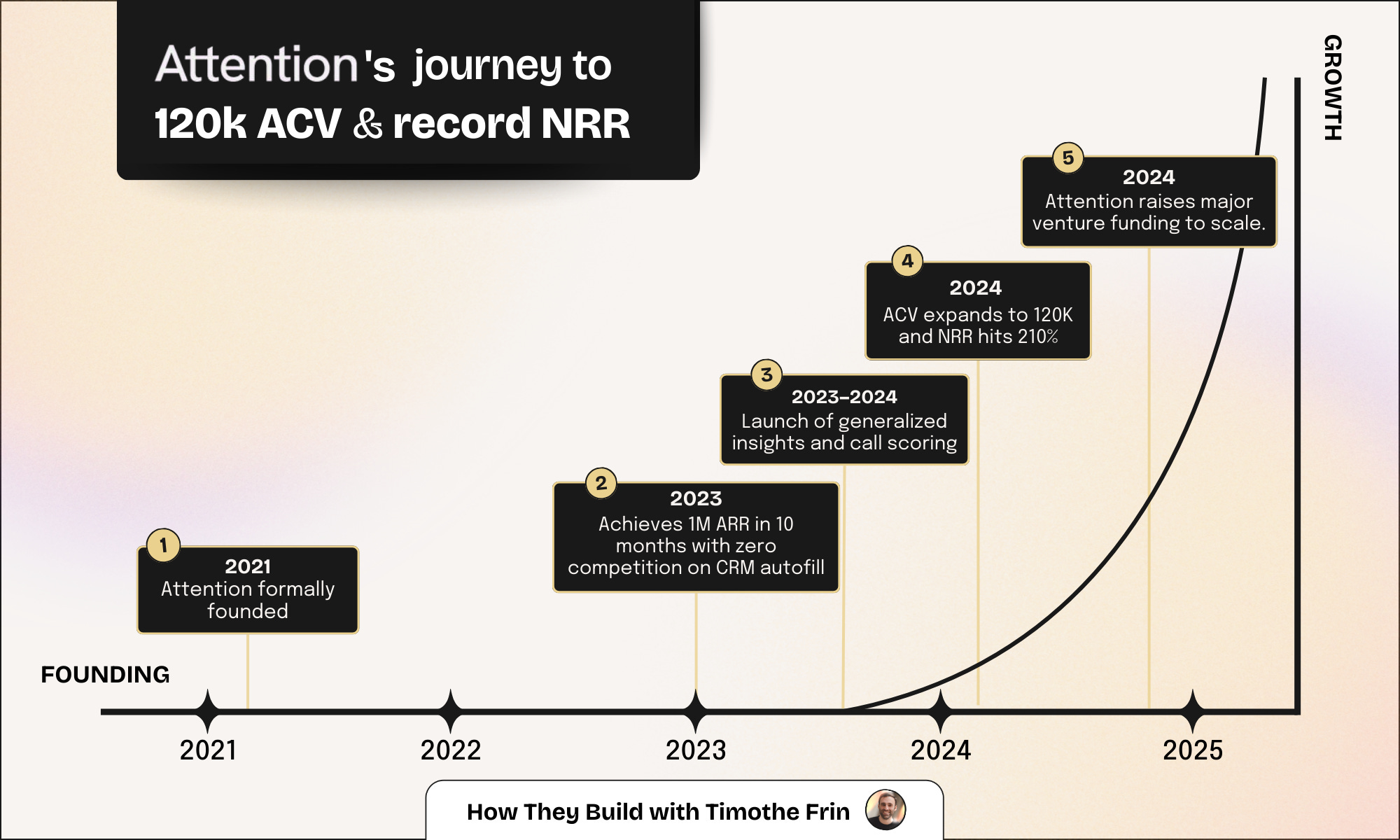
Key milestones
- 2021 – Attention formally founded.
- 2023 – Achieves 1M ARR in 10 months with zero competition on CRM autofill.
- 2023–2024 – Launch of generalized insights (multi-call intelligence) and call scoring.
- 2024 – ACV expands to 120K and NRR hits 210%.
- 2024 – Attention raises major venture funding to scale.
I sat down with Anis Bennaceur, CEO and cofounder of Attention, to discuss how to move from mono-product to multi-product without losing PMF.
Disclaimer: The organizational choices and technical solutions shared in this newsletter aren’t meant to be copied and pasted as-is. Always keep your company’s context in mind before adopting something that works elsewhere! 😊
Backstory
From the outside, Attention’s rise looks like a perfect timing story. But digging into its origins reveals an unusually tight founder–market–technology fit. The journey starts in July 2020, when GPT-3 became available to developers. At the time, both founders were competitors at their previous companies. Each independently realized that if they could segment and compress transcripts before pushing them into LLMs, they could extract structured data to automatically fill CRMs. They met for coffee a few weeks later, clicked immediately, and committed to starting a company together the following year.
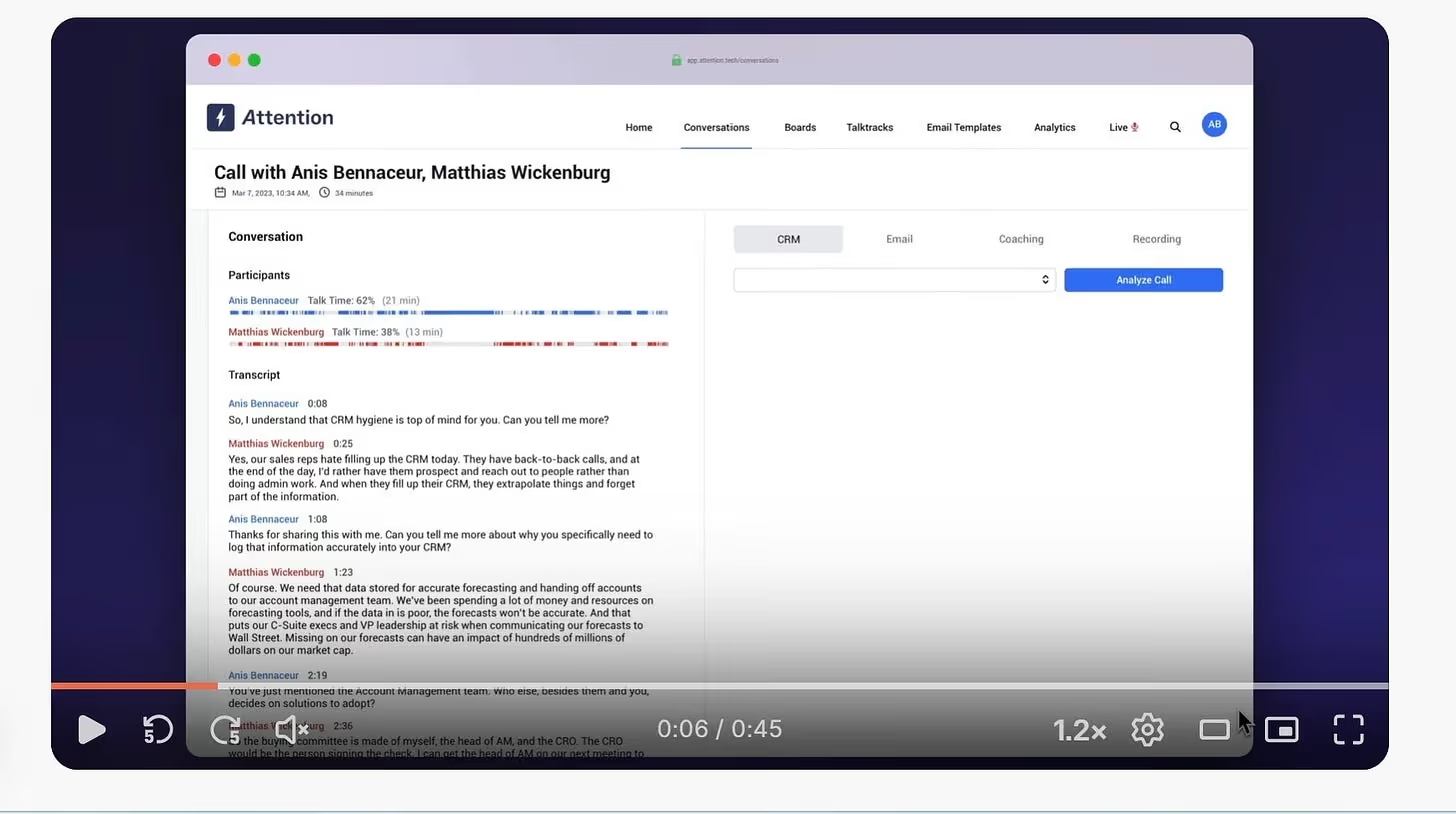
The early product was simple: take sales calls, analyze them, and autofill Salesforce or HubSpot. At first, the model quality wasn’t strong enough.
“Before, the model captured generic pains… after, it captured much more pertinent business pains” as Anis put it.
When GPT-3.5 arrived, quality jumped, hallucinations dropped, and users immediately noticed. That shift unlocked the very first signs of product-market fit: users started replying quickly to feedback messages, giving detailed input, engaging daily.
“From the moment you see that the user is interested… you know you’re on the right track” in Anis’s words
One surprising accelerator came from dogfooding. Anis was doing up to ten user calls per day and spending hours writing follow-up emails. He used their internal prototype to draft all his follow-ups faster, and when they gave the same feature to users, it became instantly valuable. The combination, CRM autofill plus follow-up drafting, created the first real wedge.
Commercialization started right after ChatGPT launched in late 2022. Inbound exploded after a TechCrunch piece announcing their seed round. They priced the product at 80/user/month, saw strong willingness to pay, raised prices to $100, then $120, then $200, all without pushback. With no competition, they hit $1M ARR in 10 months.
This early momentum became the foundation on which the multi-product platform now sits.
Solving PMF repeatedly as a multi-product company
The most delicate tension when expanding from one product to many is not losing the initial PMF. Attention’s approach is surprisingly pragmatic: PMF is defined not only by user value but by competitive advantage. When clones started appearing and pushing prices down, the team saw it as a sign that the initial wedge needed reinforcement. Instead of lowering prices, they chose innovation.
The rule was simple: if your core product grows crowded, build something that competitors don’t have. Two features emerged from real user behavior. First, customers wanted insights across many calls, not just one. They wanted to “ask” questions across hundreds of conversations. This became Generalized Insights, initially taking 10–15 minutes per query, but delivering value users never had before.
Second, a customer manually scored each of his team’s calls using a multitude of prompts pasted into the platform. That was an obvious sign of demand. Attention turned it into automated call scoring: every call evaluated by an objective agent that highlighted coaching opportunities.
These two moves extended their competitive runway for several quarters and let pricing remain high. Product selection wasn’t theoretical. It came from:
- users hacking the product, and
- the founders asking themselves, “would we use this daily?”
The same pattern repeated: ship fast, test with the smartest customers, keep what sticks, cut what doesn’t. They killed a real-time coaching feature because sales reps hated it. Everything else stayed tightly connected to revenue workflows.
Click here to view Attention’s one-pager commercial.
Building an AI product org without traditional product managers
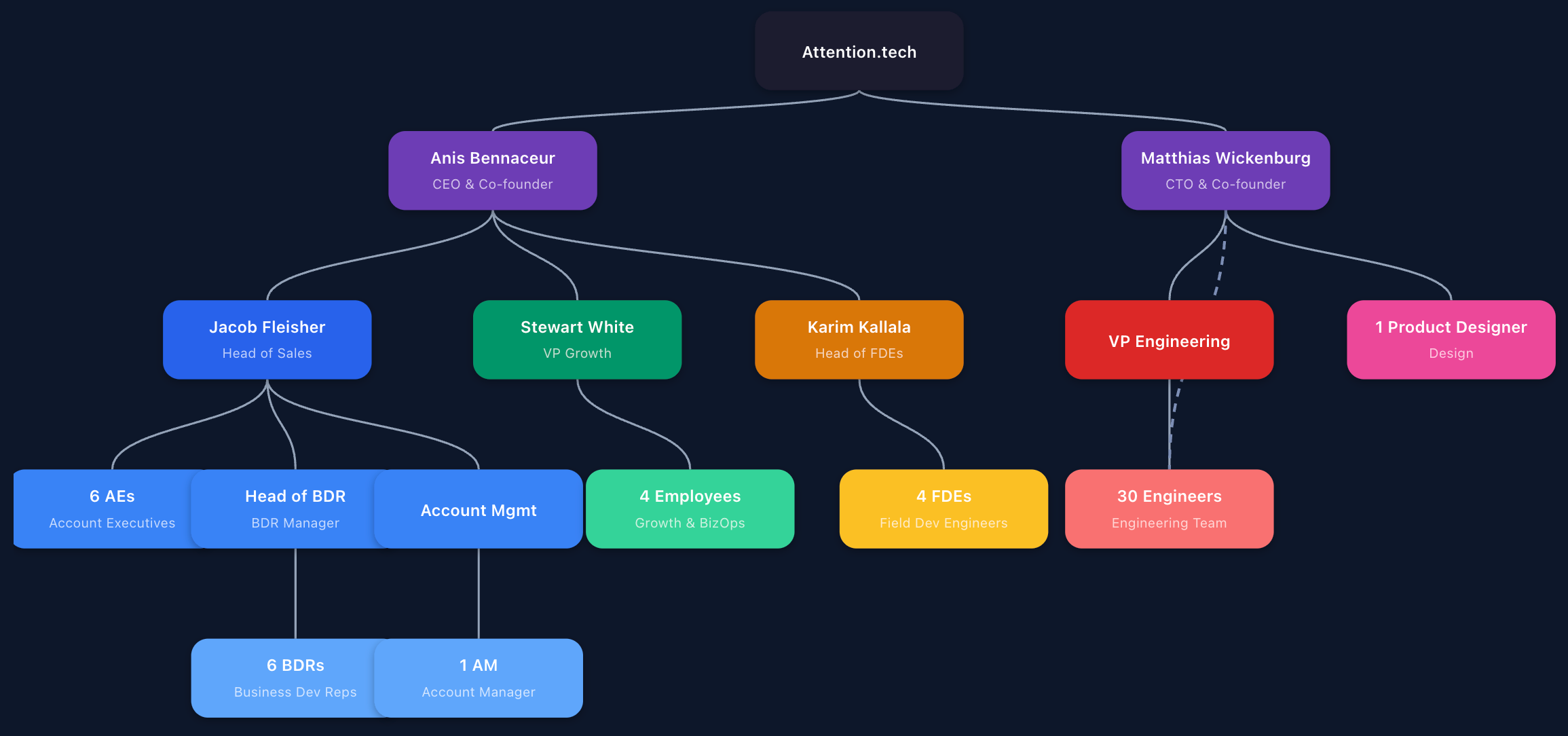
Attention is unusual in that 30 to 35 engineers report into a product org of two people. There are no product managers. Product decisions stay in the hands of the founders, following advice they got early on: don’t centralize product too early. The CTO and founding team maintained product ownership as long as possible, which worked because iteration was rapid and intuition strong.
This structure only functions because of two enablers. First, Olivia, their product designer, ships directly to production. While non-technical, she uses tools like Cursor to implement front-end changes herself, dramatically reducing product bottlenecks. Second, engineers are organized in pods aligned with product surfaces: forecasting, agentic workflows, back-end infrastructure. Each pod bridges senior and junior engineers, with Olivia pulled in when UX matters.
Interestingly, backend engineers often work without design input, because most innovation happens in AI logic and orchestration layers, not UI. Front-end touchpoints are handled only when truly needed.
The result is a hybrid product–engineering culture where engineers think in product terms and the product designer codes. There is no rigid roadmap process. The founders identify a new opportunity, build a weekend MVP, show it to 5 or 6 high-signal customers, refine based on instant feedback, and only then deploy engineering capacity.
This keeps the entire org close to market reality and lets them ship faster than competitors with larger product teams.
Designing agentic logic directly inside revenue workflows
The shift from copilots to agents is one of the biggest transformations happening in SaaS. For Attention, the distinction is simple: copilots require a human check before taking action, while agents act autonomously. The timing wasn’t obvious. Early LLMs were not reliable enough, and customers didn’t trust full automation.
So Attention followed Paul Graham’s advice: don’t start with agents; start with copilots and gradually increase autonomy. At first, users validated CRM entries manually. Then they validated emails. Over time, users told the team: we’re confident, turn off the verification. This progressive trust-building let Attention evolve the product without risky big-bang transitions.

From there, the challenge became infrastructure. Agents need to navigate messy CRM data, long-tail edge cases, and unpredictable sales workflows. To make this viable, Attention deployed Forward Deployment Engineers, who spend two weeks inside the customer’s data and team structure to ensure the product fits. This only works because Attention sells to customers with ACVs above 20K dollars per year.
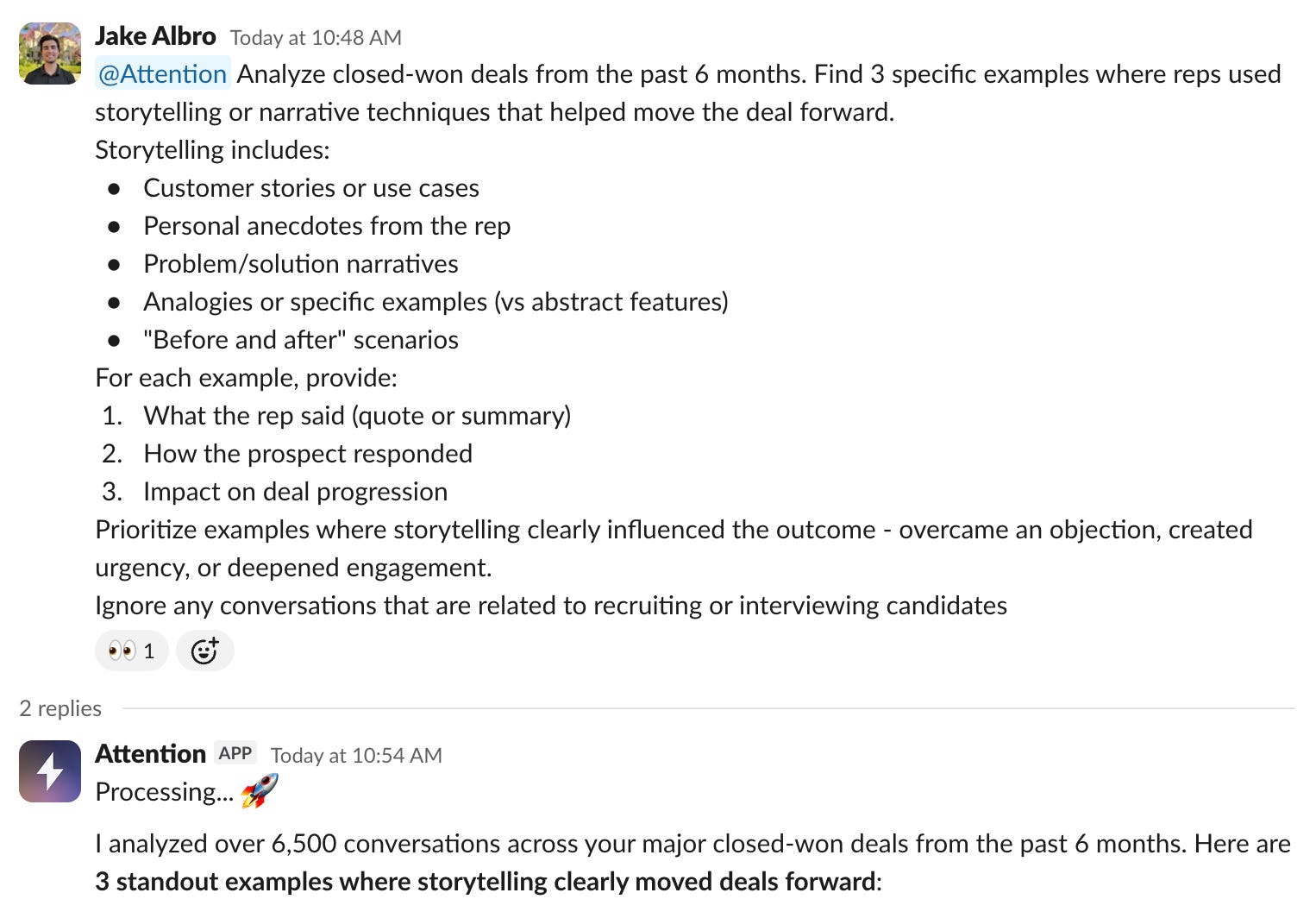
The deeper innovation now lies in autonomy. The goal is not to add more features but to improve the agent’s ability to understand users and act on their behalf. Examples include preparing daily call briefs, generating business cases when a deal hits a new stage, and nudging reps to actions they would otherwise forget.
This is where the vision emerges: eliminate Salesforce as an active tool, replacing it with a system that listens, analyzes, and acts for revenue teams.
“Our users spend almost no time in Salesforce anymore… we’re making the CRM increasingly obsolete” as Anis explains
Pricing and packaging AI in B2B when costs move fast
AI pricing is one of the hardest challenges in SaaS today. LLM costs change, models evolve, and user behavior is unpredictable. Attention manages this through a mix of hard constraints and collaborative discovery.
Internally, they target 80% gross margins, although Anis acknowledges this is difficult. Competitors set a natural ceiling; innovation sets the floor. When releasing new agentic features, they don’t force pricing. Instead, they show the feature to customers and ask what they would pay. That conversation almost never results in “zero.” The price is refined customer by customer, then validated across the base.
They also model usage patterns through internal telemetry: number of reps, number of calls recorded, emails processed, stages changed. This gives a rough estimate of the cost of running that agent for that customer. If an agent costs 1K dollars per month, they aim to charge around 4K.
Enterprise ACVs now average 120K dollars, up 15× in two years. This is possible only because value creation is obvious in time savings, strategic insights, and conversion lift. When a customer sees deals move from 20 percent to 24 percent conversion, a metric multiple customers reported, willingness to pay jumps.
The big pricing insight: you can only sell agentic workflows to organizations big enough to benefit. SMBs don’t need this sophistication. Enterprise readiness is the core of the model.
Errors & challenges
As Attention expanded its suite, the biggest mistake was building features that users didn’t truly need. The clearest example was the early real-time coaching module. It created technical debt and delivered low value. Sales reps disliked it, and LLM performance at the time didn’t support real-time action well. Keeping it alive would have slowed innovation elsewhere, so they killed it quickly and refused to sell it even when customers later asked.
The broader lesson is maintaining product sharpness. With 10 product lines, it would be easy to scatter engineering resources. Instead, the team adopted a discipline: ship only what the smartest users request or what founders would personally use. Avoid “vitamins.” Focus on painkillers.
Another challenge was preventing bottlenecks in product design. One designer for 30+ engineers is unusual, but it works only because she codes. The moment Olivia becomes overloaded, the system breaks. Attention monitors this closely and plans to hire a second product person only when engineering exceeds 40–50 people.
Finally, multi-product strategy creates complexity in onboarding. This is why deploying engineers is crucial. Without them, edge cases would explode and undermine the core promise of autonomous agents.

- Multi-product expansion is safest when driven by user hacks, not internal ideation.
- PMF is not static; competition erodes it. You must rebuild PMF by innovating faster than clones.
- Founder-led product works surprisingly well in AI, where speed and intuition beat process.
- A two-person product team can run a 60-person AI org if the designer ships code and engineers think product.
- Autonomous agents require trust; build trust through gradual removal of human-in-the-loop checkpoints.
- Enterprise ACVs grow when expansion is built into the workflow, illustrated by Attention’s 210 percent NRR.
- The smartest customers are the best product collaborators; involve them weekly, not quarterly.
- Pricing should be value-based and usage-aware; start with cost to serve, then multiply by customer ROI.
- Killing features is necessary to prevent product drift in multi-product environments.
- Internal dogfooding accelerates PMF detection by months.
- Agentic SaaS requires handling messy CRM data; onboarding engineers are often more critical than CSMs.
- Differentiation comes from autonomy, not horizontal feature count.
- Early LLM improvements can completely change PMF trajectories; stay close to model evolution.
- Repeatable multi-product execution requires pods mixing senior and junior engineers.
- Enterprise adoption of AI accelerates when value is immediate (time saved, insights generated, conversion lift).
My full interview with Attention’s CEO
Dive deeper into this topic with Anis Bennaceur, CEO of Attention, in my latest podcast episode:

Test your Product performance in 10 min
Trusted by 100+ startups and top CPOs like:


In this article
About Stellar
Stellar is a team of senior CPOs and CTOs who work hands-on inside product and engineering teams to fix what slows them down. Not advisors. Not trainers. Operators who've done the job before and know exactly where to look.
Discover StellarDive deeper
See all articles
.jpg)
.avif)
.avif)