Product Development
Inside OSS Ventures’ journey to rebuilding industrial software from the ground up
Real strategies, frameworks, and insights from leaders who built Europe's fastest-growing products.
26/2/2026
•
.png)
.avif)
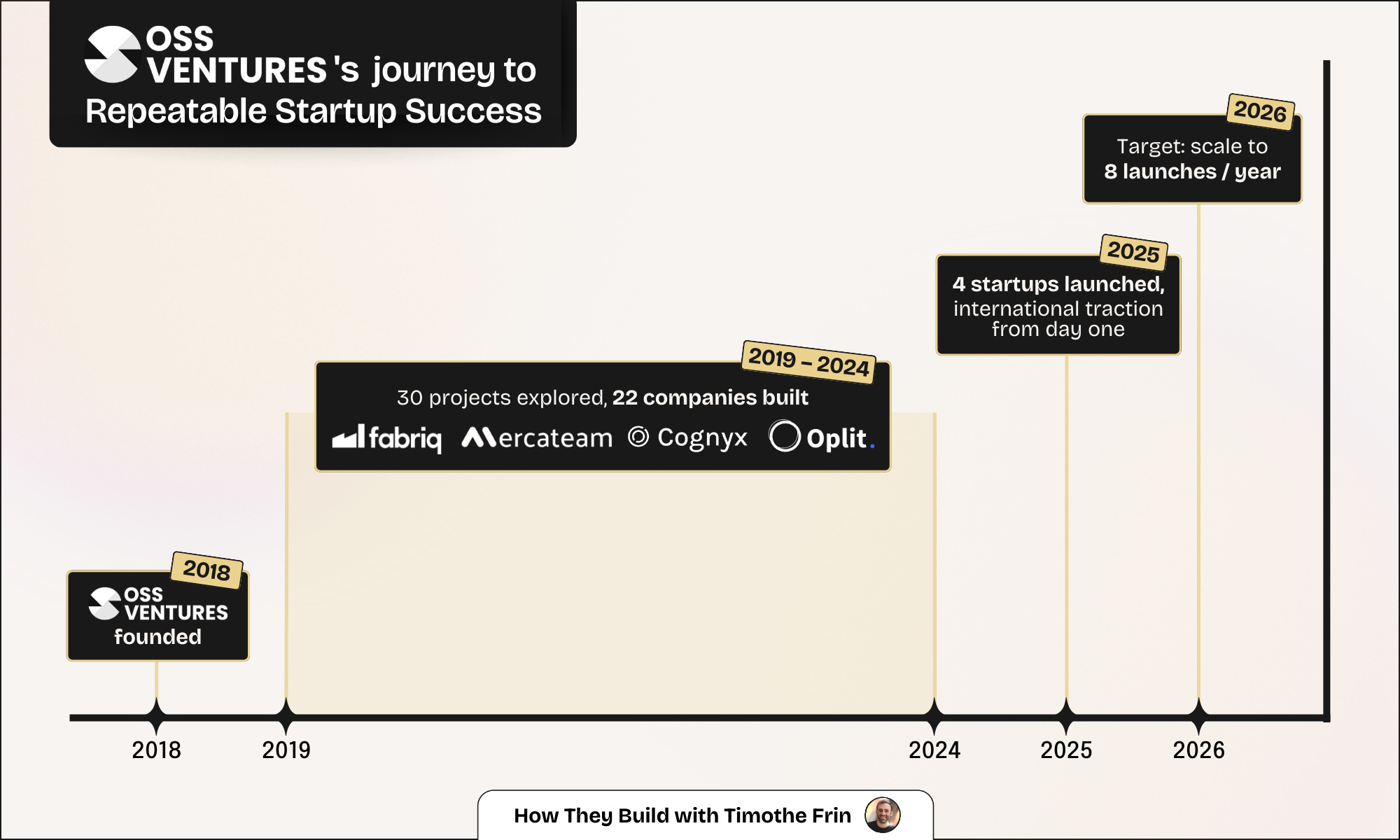
OSS Ventures was founded in 2018 by Renan Devillieres with a clear mission: use software to transform operational and manufacturing industries, where value is created in the physical world, not behind desks.
Data:
- ~30 startup projects launched since inception
- 22 active and performing startups today
- ~4 startups launched per year, target of 8 by 2026
- Startup studio + venture fund hybrid model
- Focus on capital efficiency and early ARR validation
What makes OSS Ventures different
OSS Ventures operates at the intersection of startup studio, industrial expert, and long-term investor. The team builds B2B enterprise software for factories, logistics, construction, healthcare field ops, and agriculture. Their differentiation is deep field immersion: OSS teams spend weeks inside factories, co-building products with operators, managers, and executives. Their north star is not hype-driven SaaS, but repeatable, profitable companies capable of reaching €10–20M ARR with a clear path to positive EBITDA.
Key milestones
- 2018: OSS Ventures founded
- 2019–2024: 30 projects explored, 22 companies built
- Flagship startups include Fabriq (operational performance), Mercateam (skills management), Cognyx (design to manufacturing), Oplit (industrial planning)
- 2025: 4 startups launched, international traction from day one
- 2026 target: scale to 8 launches per year
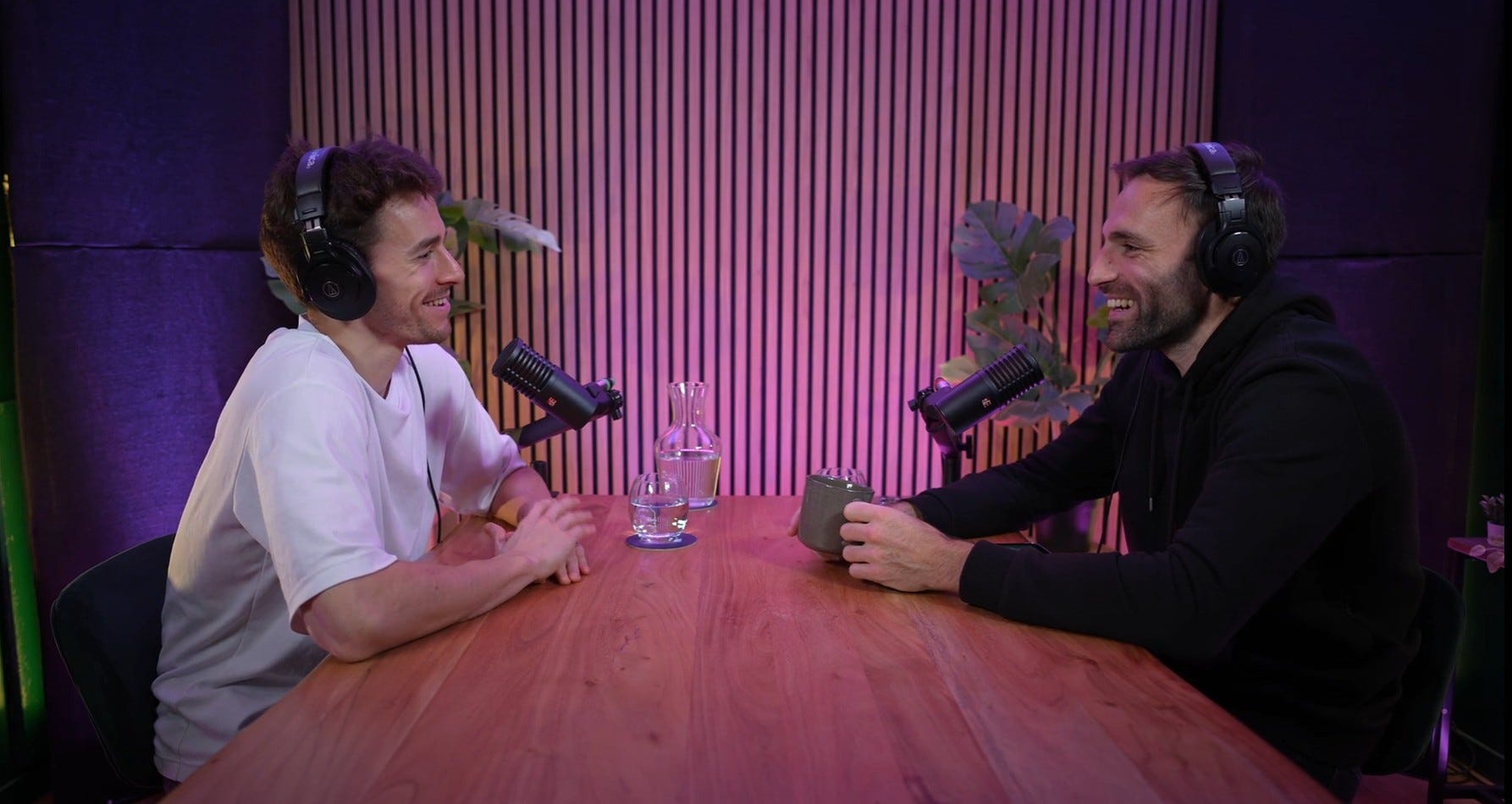
I sat down with Léopold Lambert, Head of Product chez OSS Ventures, to discuss how they go from 0 to 1 in industrial software, what makes factories a unique product playground, and why killing ideas early is a competitive advantage.
Disclaimer: The organizational choices and technical solutions shared in this newsletter aren’t meant to be copied and pasted as-is. Always keep your company’s context in mind before adopting something that works elsewhere! 😊
Backstory
Building software for factories is not a “vertical SaaS” choice for OSS Ventures. It is a conviction rooted in economic sovereignty, employment, and value creation. Léopold joined OSS Ventures six years ago as one of the first team members, after the studio was just launched. From day one, the ambition was clear: industrial operations are massively under-equipped compared to the complexity they manage daily.
Factories run with Excel sheets, whiteboards, and oral handovers while coordinating thousands of variables: machines, people, supply chains, and quality constraints. OSS Ventures saw an opportunity to increase the value each operator can create.
One core belief drives everything: operational jobs will become higher leverage. Software should give factory workers the tools to act on what they're already capable of: orchestrating complex production, making the right decisions, and managing quality, process, and supply at a level that manual processes simply won't allow. What they lack are the software tools. Giving them that leverage means higher quality, fewer errors, greater complexity handled with confidence, and ultimately a path to compete worldwide through innovation in both product and process.
This belief shaped how OSS builds companies. They start from spaces: large operational problem areas that affect 80 percent of industrial players, such as production planning, pricing, skills management, or design-to-manufacturing.
From there, everything is field-driven. OSS teams go into factories, observe daily rituals, and identify where performance breaks down. Fabriq is a perfect example. The team spent weeks observing daily problem-solving meetings on factory floors, where critical issues were written on paper or whiteboards and forgotten for months.
“We saw problems on the most critical machines that had been written on boards for three months” - Léopold Lambert
That was the spark. A systemic failure in how problems were tracked and resolved.
A brutal but effective 0→1 playbook
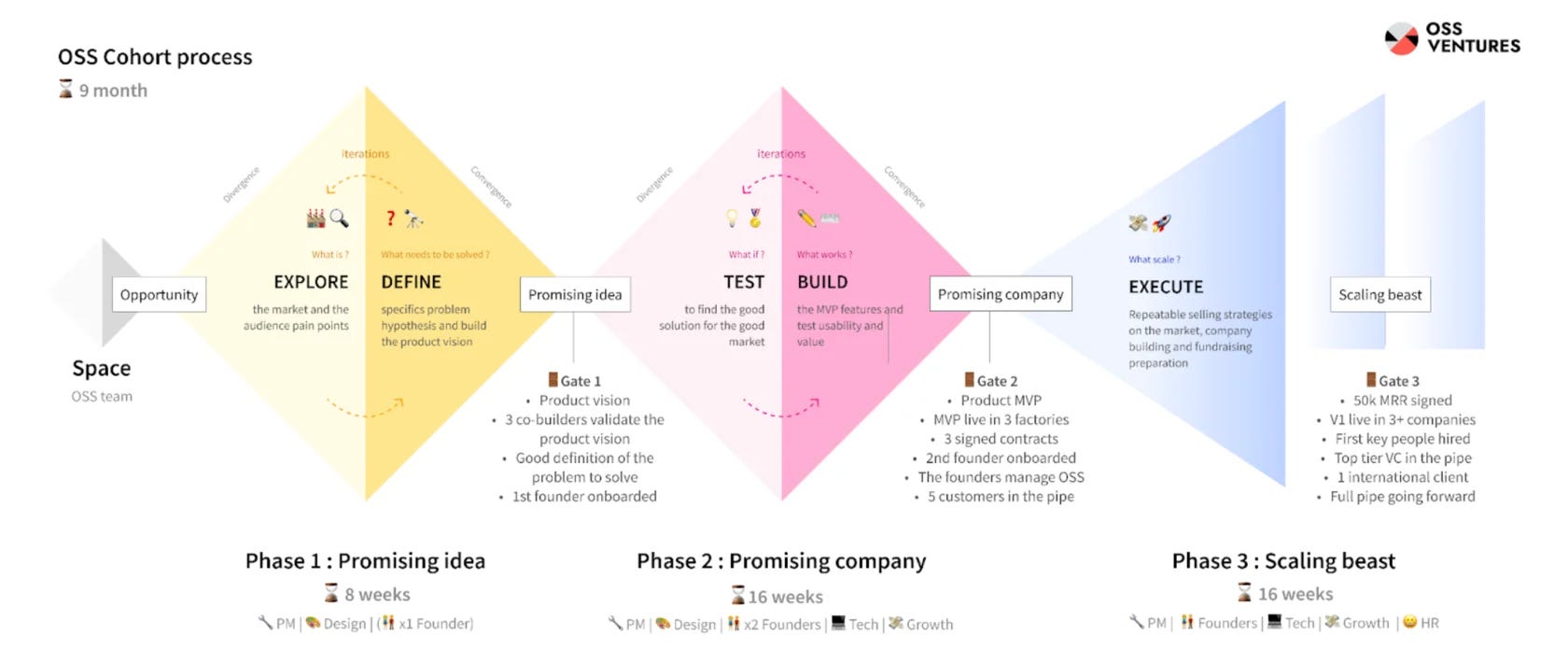
OSS Ventures uses a strict stage-gate process to avoid the most common startup studio failure: doing mature-company activities too early. Each phase has clear goals, and you are not allowed to move forward if you do not pass the gate.
Phase 1 lasts 2–3 months and includes zero production code. The objective is to deeply understand the problem and validate that it is worth solving. Teams interview 40–50 industrial players, looking for strong, repeatable signals of pain and value.
The key artifact is the “one-pager”: a short product narrative describing the problem, the differentiated value proposition, and the hypotheses to test. Every week, insights from customer interviews are reviewed collectively to identify what OSS calls “unique insights”: truths that surprise experienced industrial leaders.
If OSS cannot onboard 3 design partners willing to co-build within this timeframe, the project is killed.
“A startup is a temporary organization searching for a model. If we don’t see strong validation fast, we stop” - Léopold Lambert
Phase 2 is about landing the product in the real world. With 3 co-constructors, OSS builds a first version that delivers tangible value. The goal is real recurring contracts, typically €50k–€100k ARR within 6 months of starting.
Phase 3 focuses on repeatability. The team moves from 3 to 10 customers, identifies the most responsive segment, and sharpens go-to-market. At this point, the startup becomes autonomous, while OSS transitions into a long-term operating and investment partner.
Why industrial software is a different game
Industrial software is almost always B2B enterprise. Sales cycles can reach 6 to 9 months, users are not tech-native, and adoption varies wildly between sites. OSS Ventures embraces this instead of fighting it.
The key is co-construction. Instead of selling finished products, OSS aligns incentives with early customers by building together. Design partners commit time, data, and feedback, while OSS commits to solving real operational problems.
Adoption is treated as a signal. On Fabriq, some factories embraced the product immediately, while others resisted. OSS learned to identify early adopters and design for them first, using their success as proof points to expand later.
What helps most is the culture of radical honesty in factories. Operators will say directly if something is useless. For OSS, that honesty accelerates learning and prevents polite but deadly false positives.
The hidden advantage of killing ideas early
OSS Ventures has killed 8 out of 30 projects. And they consider this a success.
The studio aims to kill weak ideas in 1 to 2 months. Fast kills preserve team energy and capital. More importantly, OSS often keeps the founding team even when the idea dies.
“If you validate the founders on a bad idea and then put them on a good market, success becomes much more likely” - Léopold Lambert
This approach reframes failure. Killing a project is not a loss if it increases confidence in the team. OSS takes around 25% equity and considers itself a true cofounder. That responsibility forces hard conversations early, before teams burn years on mediocre opportunities.

- Industrial software is a leverage play: the goal is multiplying human impact inside complex systems.
- Starting from problem spaces instead of ideas increases the odds of finding large, valuable markets.
- A strict stage-gate process prevents premature scaling and forces clarity at every step.
- Co-construction with real operators is the fastest way to validate value in conservative environments.
- Early ARR, even from a few customers, is a stronger signal than polished demos or large pipelines.
- Killing ideas fast is not failure; it is portfolio management applied to human energy.
- Long-term studio value comes from staying relevant as an operating partner, not just an early builder.
My interview (in french 🇫🇷) with OSS Ventures, Head of Product
Dive deeper into this topic with Léopold Lambert, Head of Product at OSS Ventures, in my latest podcast episode.
Test your Product performance in 10 min
Trusted by 100+ startups and top CPOs like:


In this article
About Stellar
Stellar is a team of senior CPOs and CTOs who work hands-on inside product and engineering teams to fix what slows them down. Not advisors. Not trainers. Operators who've done the job before and know exactly where to look.
Discover StellarDive deeper
See all articles
.avif)
.avif)