

Product Vision and Strategy
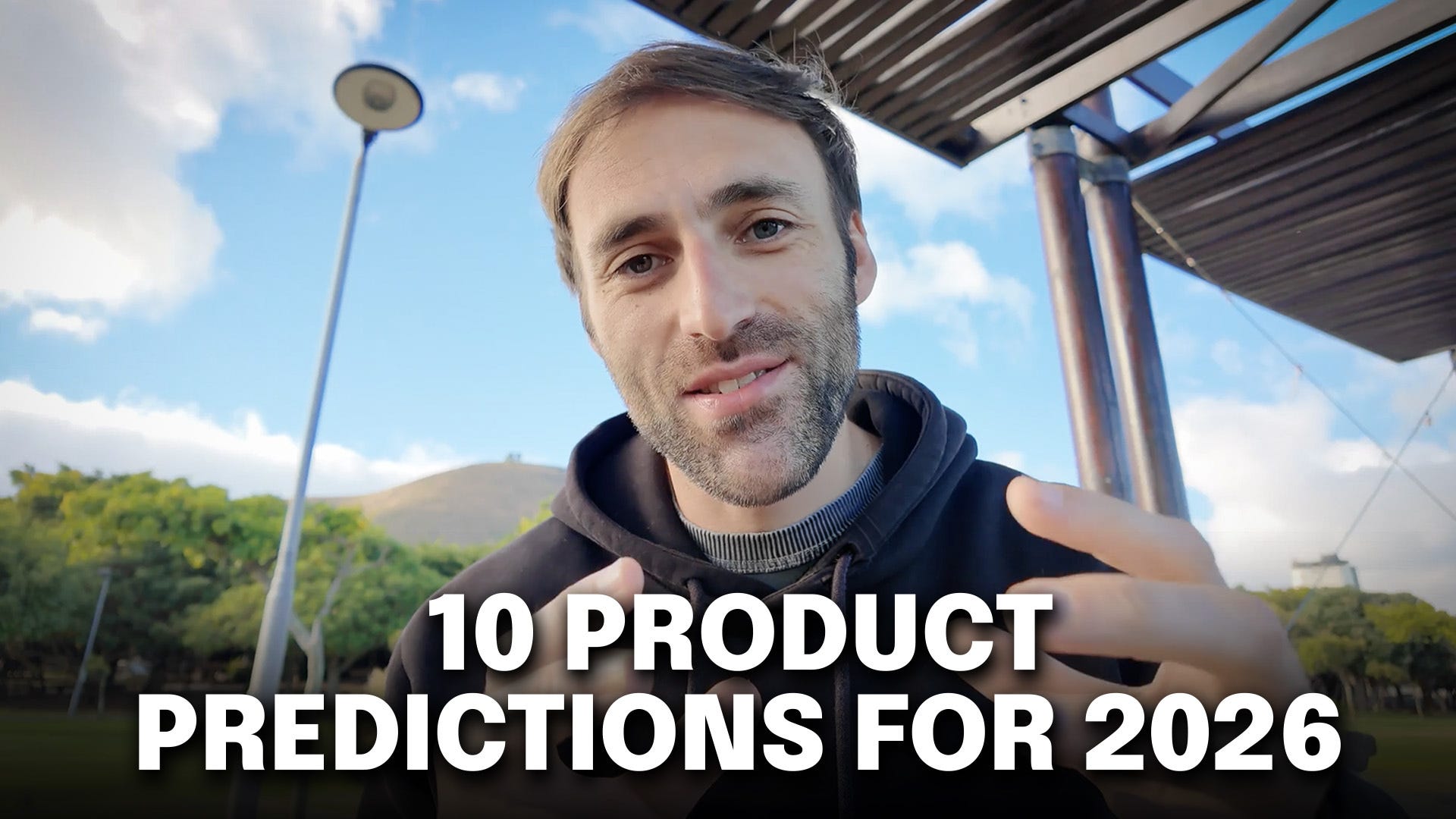
My 10 Product Predictions for 2026
Real strategies, frameworks, and insights from leaders who built Europe's fastest-growing products.
5/3/2026
•
.png)
.avif)
Over the past year, I’ve had the chance to exchange with more than 300 CEOs, CPOs and CTOs across Europe and the US about product strategy, AI adoption and org evolution.
Between documentaries I shot in Silicon Valley and Barcelona on how companies build with AI, and deep operational discussions with software execs, one thing became clear to me: 2025 was a year of questioning. 2026 will be a year of action.
2 forces are reshaping the product function:
The first is technological. AI has reached a level of quality that is transforming entire parts of the product discipline.
The second is economic. Since the post-2021 funding bubble, companies have had to rationalize costs and learn how to do at least the same, sometimes more, with fewer resources.
In this special episode, I distilled 10 concrete predictions from these conversations. They all point to the same reality: 2026 will be a year of acceleration and selection for product teams.
Disclaimer: The organizational choices and technical solutions shared in this newsletter aren’t meant to be copied and pasted as-is. Always keep your company’s context in mind before adopting something that works elsewhere! 😊
1. Product becomes the new bottleneck
But the decision itself, the ability to align people, to convince stakeholders, to take responsibility, remains deeply human.
In 2026, I believe product leaders will be judged primarily on how clearly and how quickly they decide. For years, execution speed was the constraint. Engineering bandwidth defined what was possible. Roadmaps were shaped by delivery capacity.
That constraint is disappearing fast.
With code generation tools, engineers are shipping dramatically faster. Features move from idea to production in record time. When delivery accelerates, something else slows the system down.
That “something” is decision-making.
Prioritization, trade-offs and alignment now determine performance. AI can structure information and accelerate analysis, but it does not take ownership of strategic choices. In 2026, product teams will feel the pressure of becoming the decision engine of the company.
2. AI reveals the real level of PMs
There is a lot of noise about AI replacing PMs. I do not see that happening.
What I see is amplification.
The PM landscape is uneven. Some PMs operate strategically, influence leadership and connect product decisions to business impact. Others focus mainly on coordination and backlog execution.
When AI absorbs operational workload, the remaining value lies in strategic clarity. If you know how to frame problems and define direction, AI becomes leverage. If your role is mostly process management, your scope shrinks.
In 2026, the difference between strong and average PMs will become much more visible.
3. Product becomes co-responsible for revenue
I often describe product maturity in 3 stages. At stage one, product is a support function. At stage two, it is a delivery engine. At stage three, it becomes a growth engine.
Most companies in Europe are still operating at stage two.
What I observe now is a shift toward stage three. Executive teams are asking product leaders how their roadmap impacts revenue, retention and expansion. The conversation is moving from velocity metrics to economic outcomes.
Product teams will increasingly be evaluated on business impact. Revenue accountability will no longer sit only in sales or growth. It will move structurally closer to product.
4. The CPO role evolves toward growth
If product becomes accountable for revenue, leadership must evolve.
Traditionally, the CPO focused on vision, organization and product culture. Those responsibilities remain important, but the mandate expands. Conversations around ARR, MRR and monetization become central.
The separation between product and growth is narrowing. In some companies, this may translate into structural changes or growth-oriented executive roles.
The future CPO will need to think in terms of economic impact as much as roadmap coherence.
5. The first PM becomes product growth
At early stage, hiring a first PM used to mean bringing structure and generalist coverage. The goal was to create clarity across a fast-moving organization.
What I am seeing now is different.
Founders reaching several million in ARR with lean teams are looking for metric-driven product leaders. They want profiles capable of directly moving activation, retention or expansion metrics.
The expectation shifts from managing complexity to driving measurable growth. Early-stage product is becoming inherently growth-focused.
6. AI-native workflows become mandatory
In 2025, most teams were experimenting with AI tools. They were testing use cases and observing results.
In 2026, the shift is toward implementation.
Executives are selecting a few high-impact AI use cases and redesigning workflows accordingly. Discovery synthesis, documentation, prototyping and collaboration are all being reshaped.
Teams that fail to embed AI deeply into their daily workflows will lose speed and efficiency. AI-native will become the operational baseline.
7. Traditional product metrics lose relevance
For years, product teams measured output as a proxy for impact. Tickets closed, experiments launched and features shipped were signs of productivity.
In an AI-augmented environment, output becomes easier to generate.
When AI accelerates experimentation and execution, activity metrics lose meaning. What matters is not volume, but business consequence.
Revenue impact, retention improvement and churn reduction will increasingly define performance. Product evaluation shifts from activity measurement to economic contribution.
8. 2026 brings a wave of churn
Many AI-native products have optimized for immediate wow effect. Users experience rapid value and subscribe quickly.
However, initial excitement does not always translate into long-term utility.
As renewal cycles arrive, companies reassess value. I expect 2026 to bring significant churn, especially among products built around novelty rather than sustained impact.
This dynamic will likely trigger consolidation and more acquisition activity. Retention will become the true test of product-market fit.
9. Per-seat pricing declines
Per-seat pricing has dominated SaaS for years. It aligned well with human usage patterns.
In a world increasingly driven by automated agents, the number of human users becomes less representative of value creation. Tasks and outcomes start to matter more than seats.
I expect more hybrid pricing models combining subscription and usage. Pricing per task or per outcome will gain momentum as companies experiment.
2026 will be a year of structural pricing adjustments.
10. Functional products become invisible
AI is making product execution cleaner and faster. Building functional features is becoming easier.
As functionality becomes easier to replicate, differentiation shifts elsewhere.
Opinion, taste and emotional resonance become rare assets. Brand coherence and product identity gain strategic importance. I believe brand will increasingly become a product responsibility.
In a commoditized functional landscape, identity becomes the real differentiator.
My full episode (in french 🇫🇷) on these predictions
Dive deeper into these ideas in my latest episode, where I break down all 10 predictions for the future of product in 2026.
Also available as a podcast (French for now):
Test your Product performance in 10 min
Trusted by 100+ startups and top CPOs like:


In this article
About Stellar
Stellar is a team of senior CPOs and CTOs who work hands-on inside product and engineering teams to fix what slows them down. Not advisors. Not trainers. Operators who've done the job before and know exactly where to look.
Discover StellarDive deeper
See all articles
.avif)
.avif)
