Product Market Fit
How Top Founders Find Product-Market Fit Faster
Real strategies, frameworks, and insights from leaders who built Europe's fastest-growing products.
7/5/2026
•
.png)
.avif)
In this special episode, I analyzed 4 concrete perspectives from founders chasing the same goal: finding product-market fit.
Across Timeleft, Nabla, Attention, and OSS Ventures, the contexts are very different: social experiences, healthcare infrastructure, AI sales tools, and industrial SaaS. Yet the challenge is the same everywhere. Finding product-market fit is unclear, messy, and rarely happens in a straight line.
Some founders iterate for years before seeing their first dollar. Others move fast but struggle with focus. Some rely on deep customer insight. Others wait for a technological shift to unlock real value.
What makes these stories interesting comes from the decisions they made under uncertainty, the signals they chose to trust, and the moments they realized they were getting closer to product-market fit.
I broke down these 4 perspectives to extract clear, actionable lessons on how to find product-market fit faster, especially in the early stages of a company.
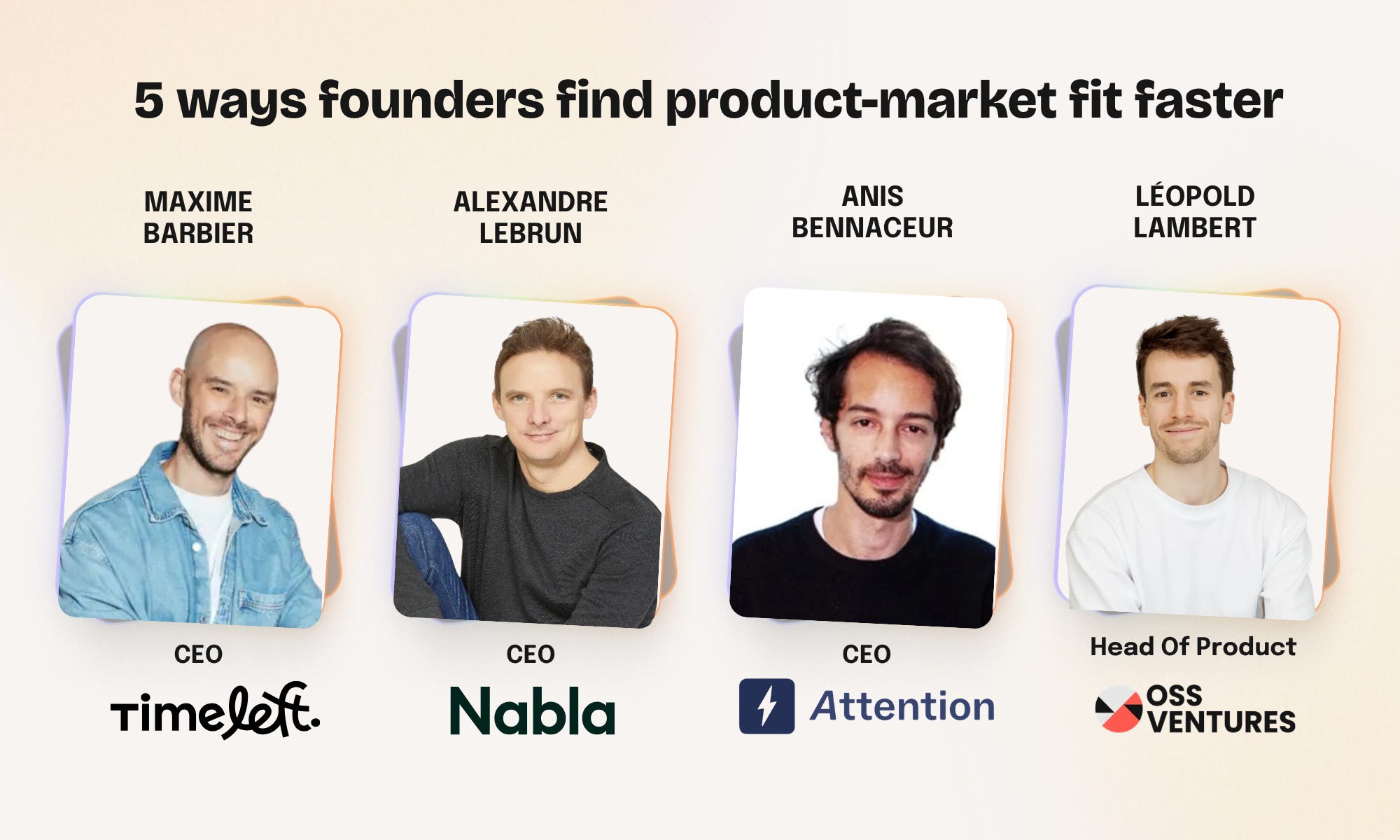
I sat down with Maxime Barbier (Co-Founder & CEO of Timeleft), Alexandre Lebrun (Co-Founder & CEO of Nabla), Anis Bennaceur (Co-Founder & CEO of Attention), and Léopold Lambert (Head of Product at OSS Ventures) to discuss how to reach product-market fit faster.
Disclaimer: The organizational choices and technical solutions shared in this newsletter aren’t meant to be copied and pasted as-is. Always keep your company’s context in mind before adopting something that works elsewhere! 😊
1. Start with the simplest version you can ship
Early-stage teams often delay launch because they want to build something complete. This instinct slows down learning and creates unnecessary complexity.
Maxime Barbier’s journey illustrates this clearly. After three years of failed iterations and increasingly complex products, the breakthrough came from a radical constraint: launch in 15 days. This forced the team to simplify everything.
Instead of building a full product, they assembled a lightweight system using Typeform, WhatsApp, and Stripe. No heavy tech, no dependencies, just a functional experience that could be tested immediately.
The impact was immediate. Users paid from day one.
“We made 125 euros the first week… and we celebrated the first 5 euros because it meant we were selling something” - Maxime Barbier
This moment validated something critical: users were willing to pay. That signal matters more than any feature set or technical achievement.
By removing complexity, they regained speed and control. They could test ideas quickly, iterate without friction, and stay close to users.
At this stage, the goal is not to build a perfect product. It is to validate whether your idea creates enough value for someone to act.
The simplest version of your product is often the fastest path to that answer.
2. Create tight feedback loops to accelerate learning
Speed is only useful if it leads to faster learning. The best teams design their product around rapid feedback cycles.
At Timeleft, weekly dinners became the core learning mechanism. Every week, users experienced the product. Every week, the team gathered insights and improved the next iteration.
This rhythm created a continuous loop of execution and feedback. Instead of waiting months for results, they learned every seven days.
Short cycles bring clarity. You quickly see what works and what does not:
- Do users show up?
- Do they enjoy the experience?
- Do they come back?
These signals are concrete and actionable.
They also keep the team close to reality. Frequent interaction with users prevents teams from drifting into assumptions or internal debates disconnected from actual needs.
Many teams postpone user exposure to improve the product first. This often leads to building in isolation.
By contrast, tight feedback loops force you to confront real usage continuously. Over time, these iterations compound into meaningful progress.
If you want to move faster toward product-market fit, reduce the time between each learning cycle.
3. Look at user behavior, not what they say
One of the biggest challenges with product-market fit is identifying it. Opinions can be misleading. Behavior is much more reliable.
At Attention, Anis Bennaceur observed a clear shift between failed experiments and early signs of product-market fit.
Before, users showed little engagement. They ignored messages, gave minimal feedback, and did not integrate the product into their workflow.
After launching a feature that automated CRM updates and follow-up emails, behavior changed dramatically.
“Users were replying within the hour with detailed feedback… that’s when you know you’re on the right track” - Anis Bennaceur
This shift is a strong signal. When users engage deeply, respond quickly, and invest time in feedback, it means the product is creating real value.
Another indicator is internal usage. Anis himself started using the product extensively, reinforcing its usefulness in real scenarios.
Product-market fit starts when users care enough to engage consistently. It is visible in their actions:
- faster responses,
- more detailed feedback,
- repeated usage.
If users are disengaged, the signal is equally clear.
Focus on what users do, not what they say.
4. Stay focused even when you have resources
Having strong resources can be an advantage, but it also introduces risk. Without constraints, teams tend to expand too quickly.
At Nabla, Alexandre Lebrun experienced this firsthand. The team built a comprehensive product covering multiple use cases within healthcare. Over time, the scope expanded significantly.
“You think you’re safe because you’re in a vertical… and one day you realize you’ve built a huge horizontal product” - Alexandre Lebrun
This kind of expansion makes it harder to identify the core value of the product. It dilutes focus and slows down the path to product-market fit.
Interestingly, limited resources can create better discipline. When you cannot do everything, you are forced to prioritize what matters most.
Abundant resources remove that pressure. Teams may build more features instead of refining the most important ones.
The key is to define clear boundaries. Even within a specific industry, your product must stay focused on a narrow problem.
Product-market fit emerges from depth, not breadth.
5. Build on strong, validated customer insights
Speed and focus must be grounded in a deep understanding of users. Without that, iteration becomes guesswork.
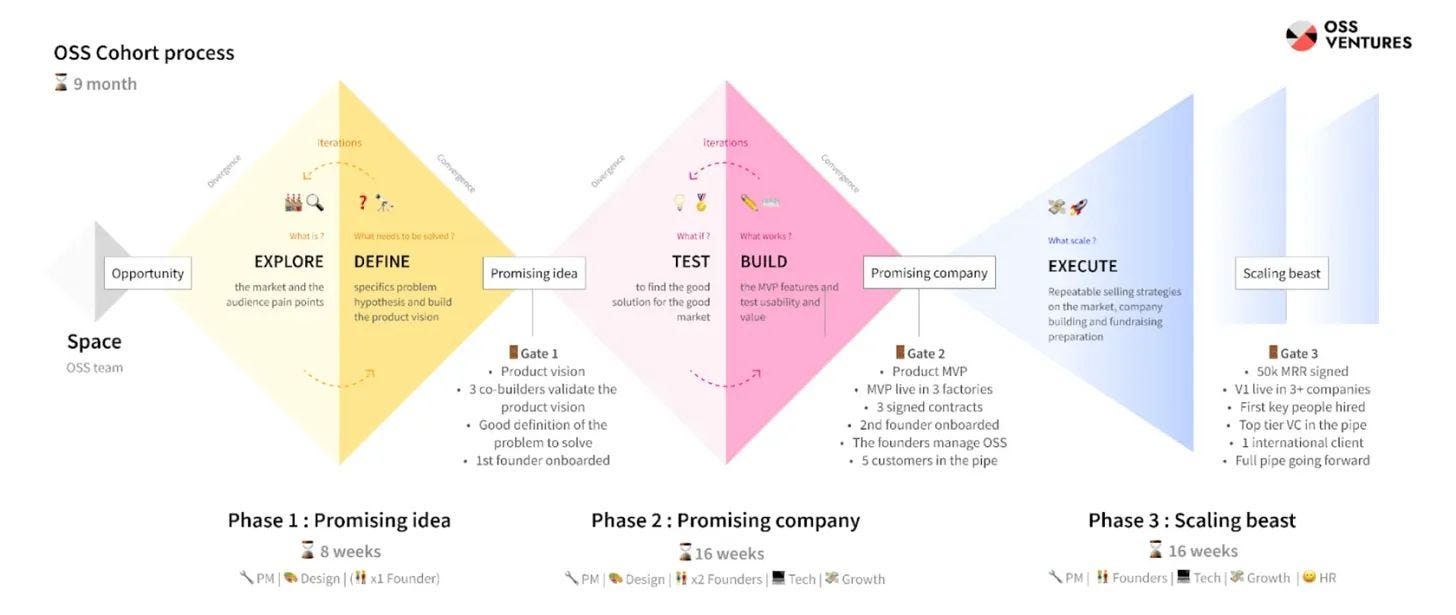
At OSS Ventures, Léopold Lambert describes a structured approach to building products from real market needs. Instead of starting from ideas, they start from problem spaces that affect a large part of the market.
The process involves extensive research, including dozens of customer interviews. The goal is to identify strong signals that indicate meaningful opportunities.
“A strong signal is something that teaches even an expert something new” - Léopold Lambert
This definition sets a high bar. It ensures the product is built on insights that go beyond obvious pain points.
Another key element is co-construction. By involving early users directly, the team validates ideas continuously and refines the product in collaboration with customers.
This approach reduces the risk of building something irrelevant. It also creates early alignment between product and market needs.
Product-market fit depends on the quality of your initial understanding. Strong insights accelerate everything that follows.
Error: adding complexity too early slows everything down
A common mistake across these journeys is adding complexity before validating value.
Maxime Barbier describes how simple ideas often became overloaded with features before launch. Each iteration added more functionality, making the product harder to build and test.
This pattern increases development time, reduces clarity, and delays feedback. It also makes it difficult to identify which part of the product actually creates value.
Another dimension of this mistake is overestimating the importance of technology early on. Many teams believe they need a robust system to succeed.
Timeleft proved the opposite. They reached significant scale using low-code tools before investing in more complex infrastructure.
Complexity should come later, once value is clearly established. At the beginning, simplicity is a strategic advantage.
The goal is to validate quickly, learn fast, and evolve progressively. Every layer of complexity should be justified by real user demand.
Avoid building for hypothetical needs. Build based on what users have already validated.

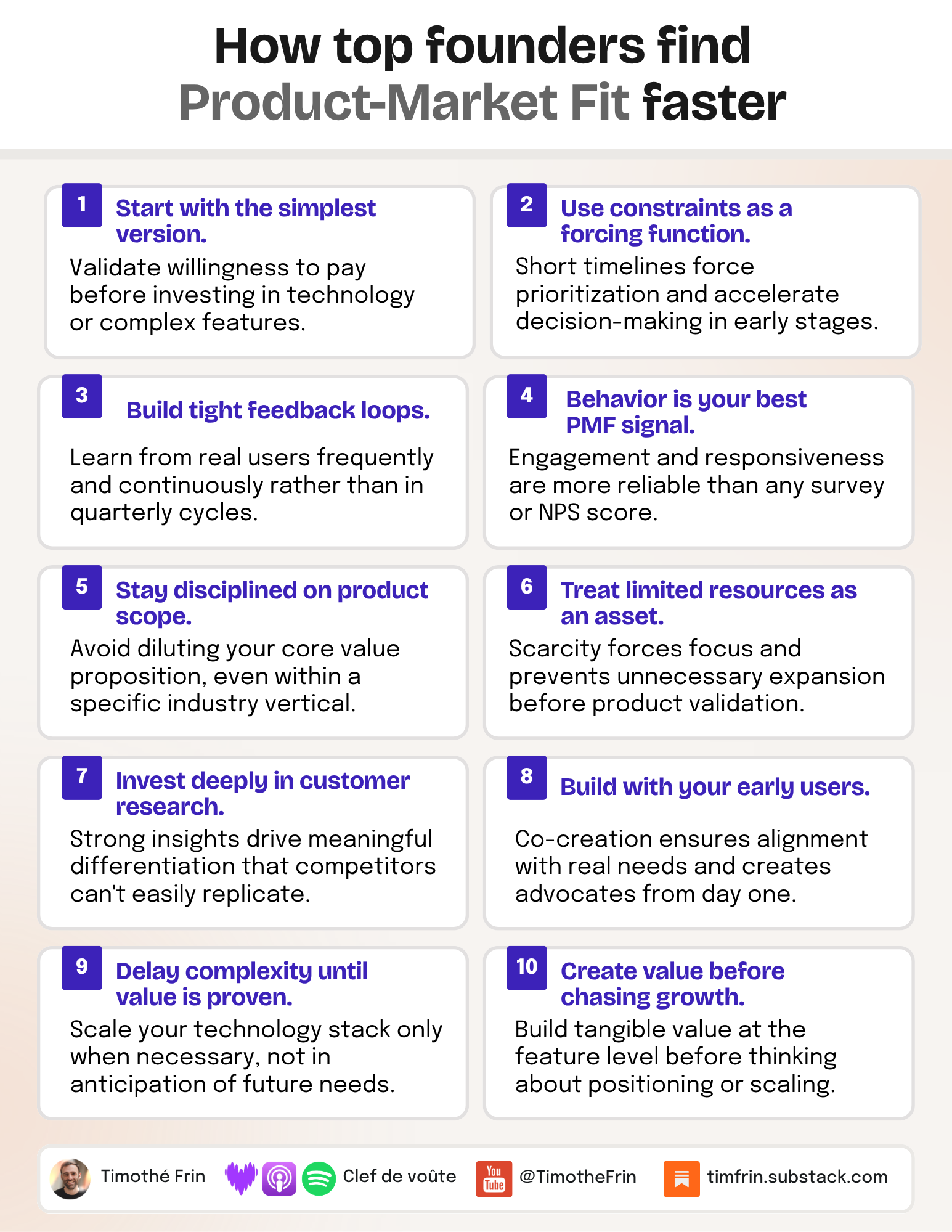
- Start with the simplest version of your product to validate willingness to pay before investing in technology or complex features.
- Use strong constraints such as short timelines to force prioritization and accelerate decision-making in early stages.
- Design tight feedback loops that allow you to learn from real users frequently and improve continuously.
- Pay close attention to user behavior, especially engagement and responsiveness, as the most reliable signal of product-market fit.
- Stay disciplined on product scope, even within a specific industry, to avoid diluting your core value proposition.
- Treat limited resources as an advantage that forces focus and prevents unnecessary expansion of the product.
- Invest time in deep customer research to uncover strong insights that can drive meaningful differentiation.
- Build products in collaboration with early users to ensure alignment with real needs from the beginning.
- Delay complexity until your product has proven value, and scale your technology only when necessary.
- Focus on creating tangible value at the feature level before thinking about growth, positioning, or scaling.
My full video with these leaders
Dive deeper into this topic with Maxime Barbier, Alexandre Lebrun, Anis Bennaceur, and Léopold Lambert in my latest podcast episode:

Test your Product performance in 10 min
Trusted by 100+ startups and top CPOs like:


In this article
About Stellar
Stellar is a team of senior CPOs and CTOs who work hands-on inside product and engineering teams to fix what slows them down. Not advisors. Not trainers. Operators who've done the job before and know exactly where to look.
Discover StellarDive deeper
See all articles
.avif)
.avif)