
AI
How Front is turning product teams into AI-powered growth engines
Real strategies, frameworks, and insights from leaders who built Europe's fastest-growing products.
30/4/2026
•
.avif)
.avif)
Backstory
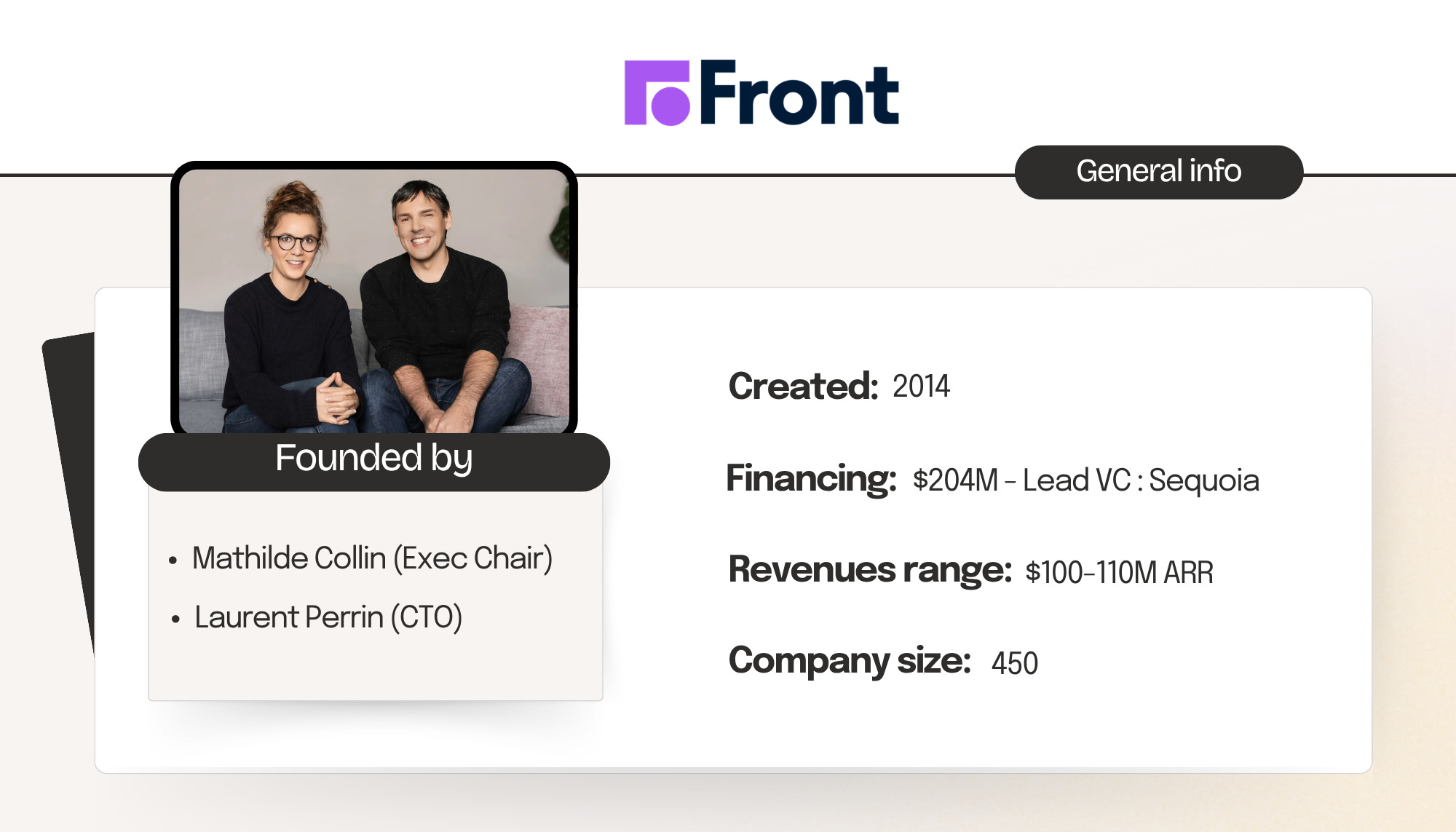
Front is a customer communication platform designed for businesses with complex support workflows and high-touch customer relationships. The company has positioned itself as a premium alternative to traditional helpdesk tools, focusing on collaborative inboxes and increasingly, AI-powered automation.
Founded in 2014 by Mathilde Collin and Laurent Perrin, Front has grown into a global company serving over 9,000 customers and generating more than $100M in annual recurring revenue. Its product has evolved from shared inbox management to a broader platform that integrates communication, workflows, and automation across teams.
The company operates across San Francisco, Paris, and Santiago, with a product team of around 20 people within a total headcount of about 450. Over the past year, Front has undergone a significant transformation toward becoming an AI-native company, with around 70% of its product and engineering organization now using AI tools daily.
This shift is reshaping not only how products are built, but how teams are structured, how decisions are made, and how value is delivered to customers.
I sat down with Paul Teyssier, Chief Product and Experience Officer at Front, to discuss how AI is reshaping product teams, how prototyping is becoming the new decision engine, and how to turn product organizations into true drivers of revenue.
Disclaimer: The organizational choices and technical solutions shared in this newsletter aren’t meant to be copied and pasted as-is. Always keep your company’s context in mind before adopting something that works elsewhere! 😊
Prototyping became the fastest path to alignment
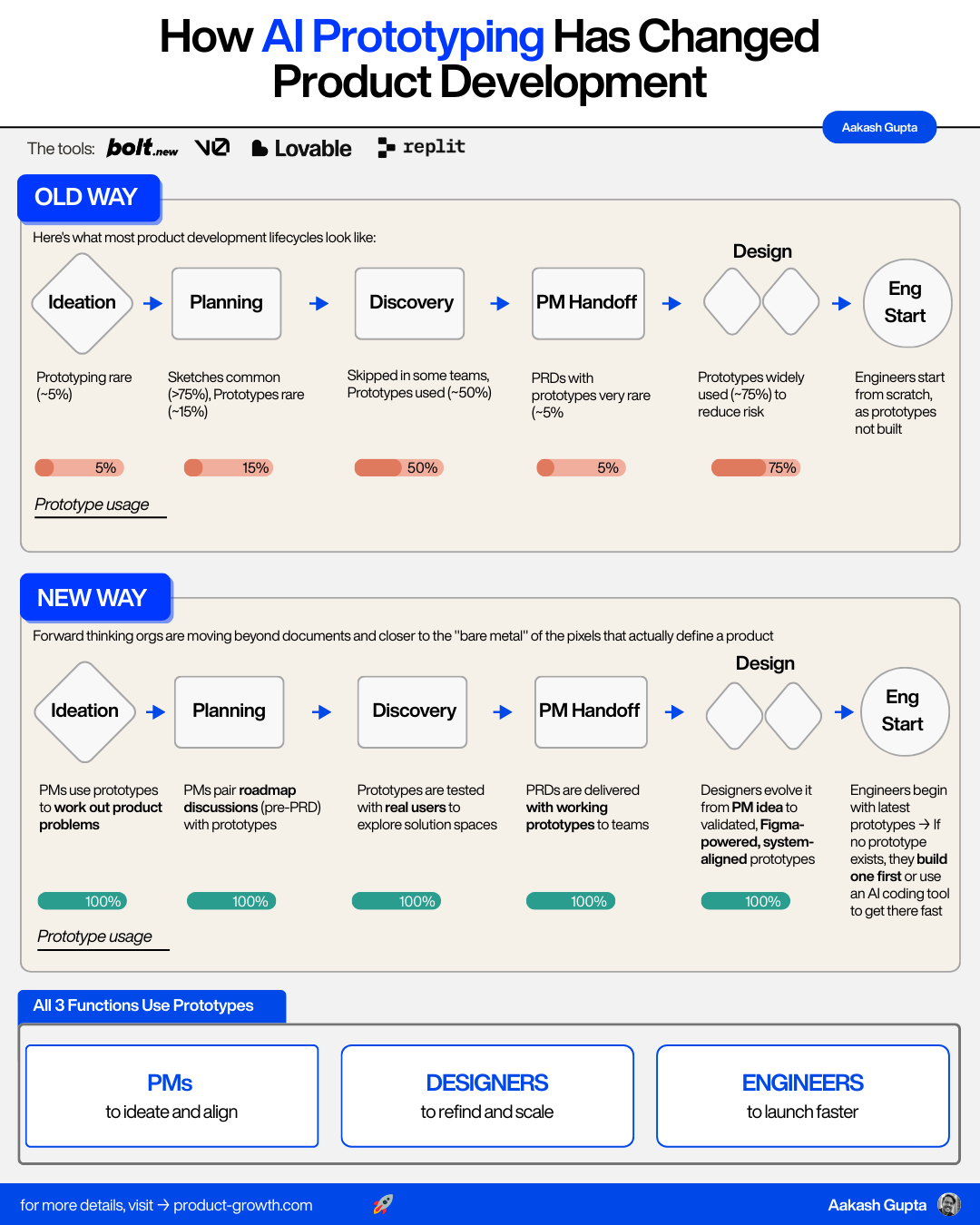
One of the most immediate changes brought by AI at Front is how quickly ideas can become tangible. What used to require multiple steps across product, design, and engineering can now be compressed into a few days.
In one example, a product manager built a working prototype of a new AI product in just a few days. Within a week, the team had something that behaved like a real product and could be shared internally and externally. This drastically accelerated alignment and decision-making across the organization.
“In one week end to end, he was able to make a hyper compelling pitch internally and align everyone really fast” - Paul Teyssier
The key shift here is the level of fidelity. Teams are no longer debating abstract concepts or reviewing static mockups. They are interacting with something functional, which makes feedback more concrete and decisions more grounded.
This also changes who can contribute. Prototyping is no longer limited to designers or engineers. Product managers and other team members can build and test ideas directly. As a result, the prototype becomes the central artifact of product thinking, replacing traditional specs and reducing reliance on design-only deliverables.
AI is removing engineering as the primary bottleneck
For years, engineering capacity has been the main constraint in product development. Most prioritization decisions were shaped by limited engineering bandwidth. At Front, this assumption is starting to break.
AI significantly increases engineering velocity and shifts engineers’ focus toward higher-level tasks such as architecture, review, and strategic decisions. As a result, teams can build more than ever before.
However, this does not eliminate constraints. It simply moves them.
“The shift from mostly engineering bottleneck is going to move toward decision quality and go-to-market” - Paul Teyssier
Two new bottlenecks are emerging. The first is decision quality. When it becomes easy to build, the risk of building the wrong thing increases. Teams must develop stronger judgment, deeper customer understanding, and clearer strategic thinking.
The second bottleneck is go-to-market capacity. Even if product teams can ship more features, customers and sales teams can only absorb a limited amount of change. At Front, this is already visible. The team can produce more improvements than the market can realistically handle at once.
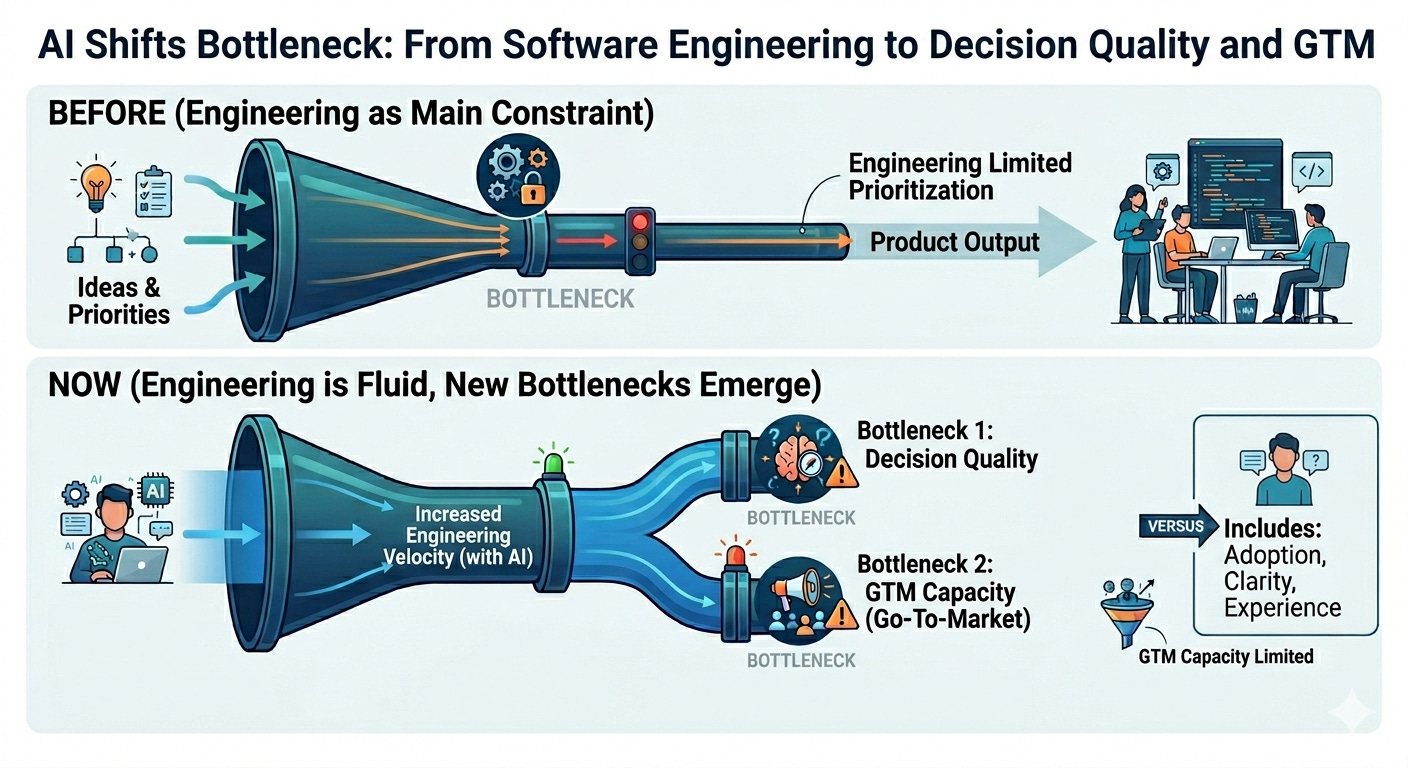
This fundamentally changes prioritization. It is no longer just about effort versus impact. It now includes customer adoption, clarity of messaging, and the ability to deliver high-quality experiences at scale.
Product, design, and engineering roles are blending
AI is also reshaping how product teams are structured. Traditional role boundaries are becoming less rigid as more people gain the ability to interact directly with code and build functional prototypes.
At Front, this leads to a more collaborative way of working, where the artifact itself is shared across roles.
“The artifact that is being worked on is going to be a lot more collaborative” - Paul Teyssier
The ratio between product managers and engineers is expected to shift significantly, potentially moving from around one PM for five engineers to closer to one for two. This reflects a broader change in responsibilities, where product managers take on more scope and engineers focus more on leverage and quality.
Roles are becoming more hybrid. Designers are involved beyond visual execution, product managers engage more directly with implementation, and engineers contribute more to strategic decisions. At the same time, core skills such as design taste and strategic thinking remain critical and difficult to replicate.
The result is a more flexible organization where impact depends less on job titles and more on capabilities and ownership.
Discovery and delivery are collapsing into one loop
One of the most profound changes is the disappearance of the traditional boundary between discovery and delivery. In the past, teams would first explore ideas, then build them. At Front, this distinction is becoming increasingly blurred.
“The line between discovering ideas to prototyping to building the real product is now blurring quite a bit” - Paul Teyssier
Because prototypes are now highly functional, they serve both as exploration tools and as early versions of the product. This creates a continuous loop where ideas are quickly tested, refined, and sometimes directly turned into production features.
This increases the number of ideas that can be explored, but it also introduces new challenges. The product surface area expands rapidly, and the risk of adding unnecessary complexity grows.
To manage this, teams must develop stronger prioritization discipline. It becomes essential to ensure that every addition delivers real value and maintains a high level of quality. The challenge is no longer generating ideas. It is selecting the right ones to pursue and scale.
Turning product teams into owners of revenue
Beyond workflows and tools, AI is accelerating a deeper organizational shift. Product and engineering teams are moving from being delivery functions to becoming co-owners of business outcomes.
This transition typically happens as companies grow and develop multiple product lines or value streams. At that stage, the CEO can no longer own all decisions, and responsibility must be distributed across the organization.
At Front, this means product managers increasingly operate like general managers of their product areas.
“Getting the product line to 1 million, 2 million, 10 million, that’s the kind of thing that matters” - Paul Teyssier
Success is no longer measured by shipping features, but by driving revenue and impact. Product leaders are expected to engage across functions, including sales, marketing, and customer support. Discussions shift from roadmap updates to business reviews.
This model requires a different mindset. Paul describes it as “founder energy” meaning the willingness to do whatever is necessary to achieve outcomes. It also requires developing new skills and embracing a broader scope of responsibility.
Why go-to-market becomes the real constraint
As the cost of building products decreases, the importance of go-to-market increases. This creates a paradox where execution becomes easier, but distribution becomes more challenging.
At Front, the team can generate more product improvements than it can effectively bring to market. Sales teams can only communicate a limited number of changes, and customers can only absorb so much at once.
This introduces a new layer of prioritization. Product teams must consider not only what to build, but also what can be successfully adopted and understood by the market.
At the same time, differentiation is evolving. As more products converge in capabilities, trust, reliability, and brand become more important. Product strategy and go-to-market strategy become deeply interconnected.
Shipping features is no longer sufficient. Ensuring adoption and impact becomes the real challenge.
The hidden challenge: developing business-minded product leaders
One of the most under-discussed challenges in this transformation is talent. Moving toward a revenue-driven product organization requires product leaders to develop strong business skills.
This includes understanding sales processes, designing go-to-market strategies, and connecting product decisions to revenue outcomes. These skills are not traditionally emphasized in product roles and can be difficult to acquire.
There is also a cultural dimension. In some ecosystems, professionals naturally think in terms of business impact. In others, this mindset is less common, which creates a gap.
Motivation plays a key role. Product leaders need to genuinely want this level of ownership and responsibility. Without that drive, the transition becomes significantly harder.
Organizations that expect product teams to own growth must also invest in helping them build the necessary skills.

- AI is reshaping not only execution speed but how product decisions are explored, validated, and scaled across teams.
- High-fidelity prototyping is becoming the fastest and most effective way to align stakeholders and de-risk ideas early.
- The main bottleneck is shifting toward decision quality and go-to-market capacity rather than engineering bandwidth.
- Product, design, and engineering roles are blending, requiring more hybrid skill sets and shared ownership.
- Discovery and delivery are merging into a continuous loop, increasing both speed and complexity in prioritization.
- Product teams are increasingly expected to own business outcomes and operate with a general manager mindset.
- Go-to-market capabilities are becoming critical as customer attention and adoption capacity remain limited.
- Developing strong business acumen in product leaders is a major and under-addressed challenge.
- Prioritization is becoming harder as the number of buildable ideas increases significantly.
- Founder-like ownership and adaptability are becoming key traits for high-impact product leaders.
Test your Product performance in 10 min
Trusted by 100+ startups and top CPOs like:


In this article
About Stellar
Stellar is a team of senior CPOs and CTOs who work hands-on inside product and engineering teams to fix what slows them down. Not advisors. Not trainers. Operators who've done the job before and know exactly where to look.
Discover StellarDive deeper
See all articles
.avif)
.avif)