
Product Market Fit
Linear’s Playbook for building a world-class Product
Real strategies, frameworks, and insights from leaders who built Europe's fastest-growing products.
28/8/2025
•
%201.avif)
.avif)
Backstory
Founded in 2019 by Karri Saarinen, Jori Lallo, and Tuomas Artman, Linear set out to reinvent how product and engineering teams track issues, plan work and ship faster. The founding team built Linear as a tool with a strong opinion on how teams should organize, removing unnecessary complexity so makers can focus on building rather than managing process.
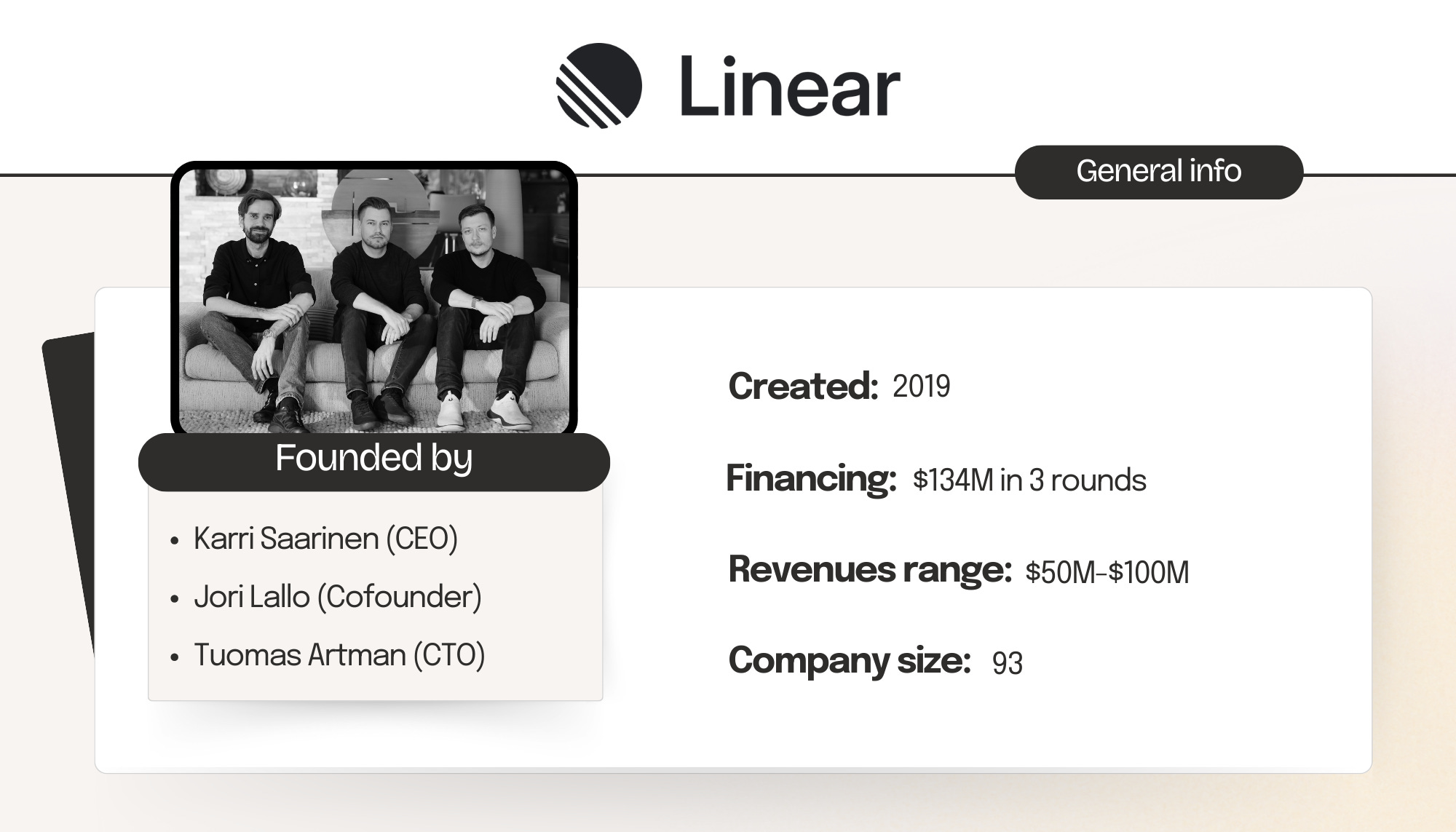
In just a few years, Linear has grown to over:
- 15,000 paying customers
- a $1.25B valuation
- 93 people in total
- 40+ people across Product, Engineering, Design, and Data
Linear is profitable, having grown profits by 280% over the past year. Its customers range from early-stage startups to high-growth scale-ups and the product has become a go-to for some of the most influential names in tech.
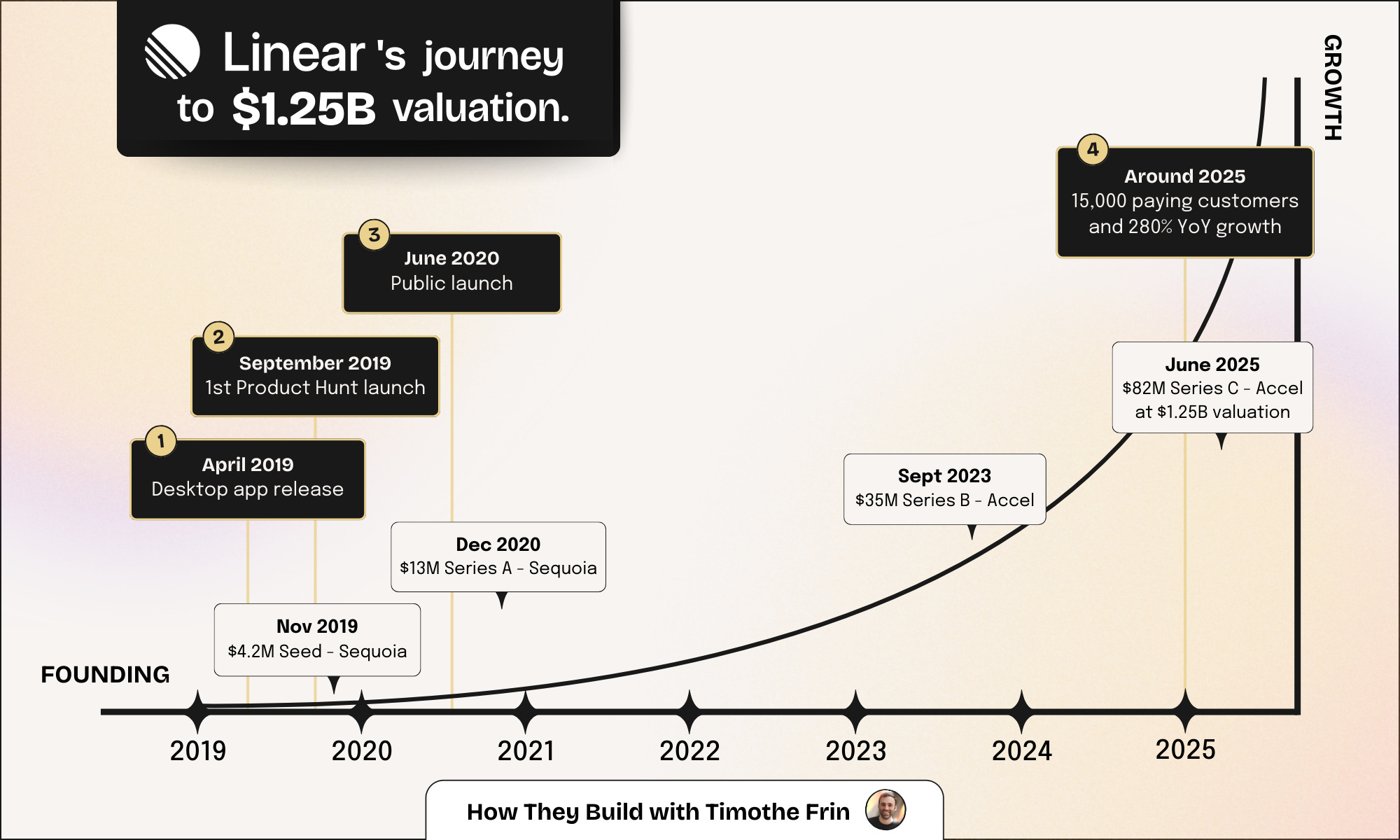
Here’s a look at the key milestones that shaped Linear’s journey:
- April 2019: Desktop app release
- September 2019: 1st Product Hunt launch
- November 2019: $4.2M Seed round (Sequoia)
- June 2020: Public launch
- December 2020: $13M Series A (Sequoia)
- September 2023: $35M Series B (Accel)
- Around 2025: 15,000 paying customers & 280% YoY growth
- June 2025: $82M Series C (Accel) at $1.25B valuation
Despite this reach, Linear has kept its marketing spend minimal, relying instead on product quality, word of mouth, and a brand that resonates deeply with makers.
I sat down with Adrien Griveau, Founding Designer at Linear, to discuss how the company accelerated ARR using the Slack Curve strategy.
The Slack Curve Strategy: win one segment at a time
The Slack Curve is a go-to-market and Product development approach that focuses on nailing one customer segment before expanding to the next. Instead of trying to serve every potential user at once, you identify a specific “pool” — often defined by team size, complexity, or use case — and focus all product, support, and marketing resources on making that segment wildly successful.
In Slack’s case, the first target was small teams, because they were easier to win, onboard, and retain. Once the product fit that audience perfectly, Slack moved to slightly larger teams, and repeated the process — each step expanding the total addressable market without losing product coherence.
Linear adopted this method by starting with teams of 1–20 people, optimizing the experience for them in self-serve mode, and only moving to the next pool when the product could handle the increased demands without compromise.
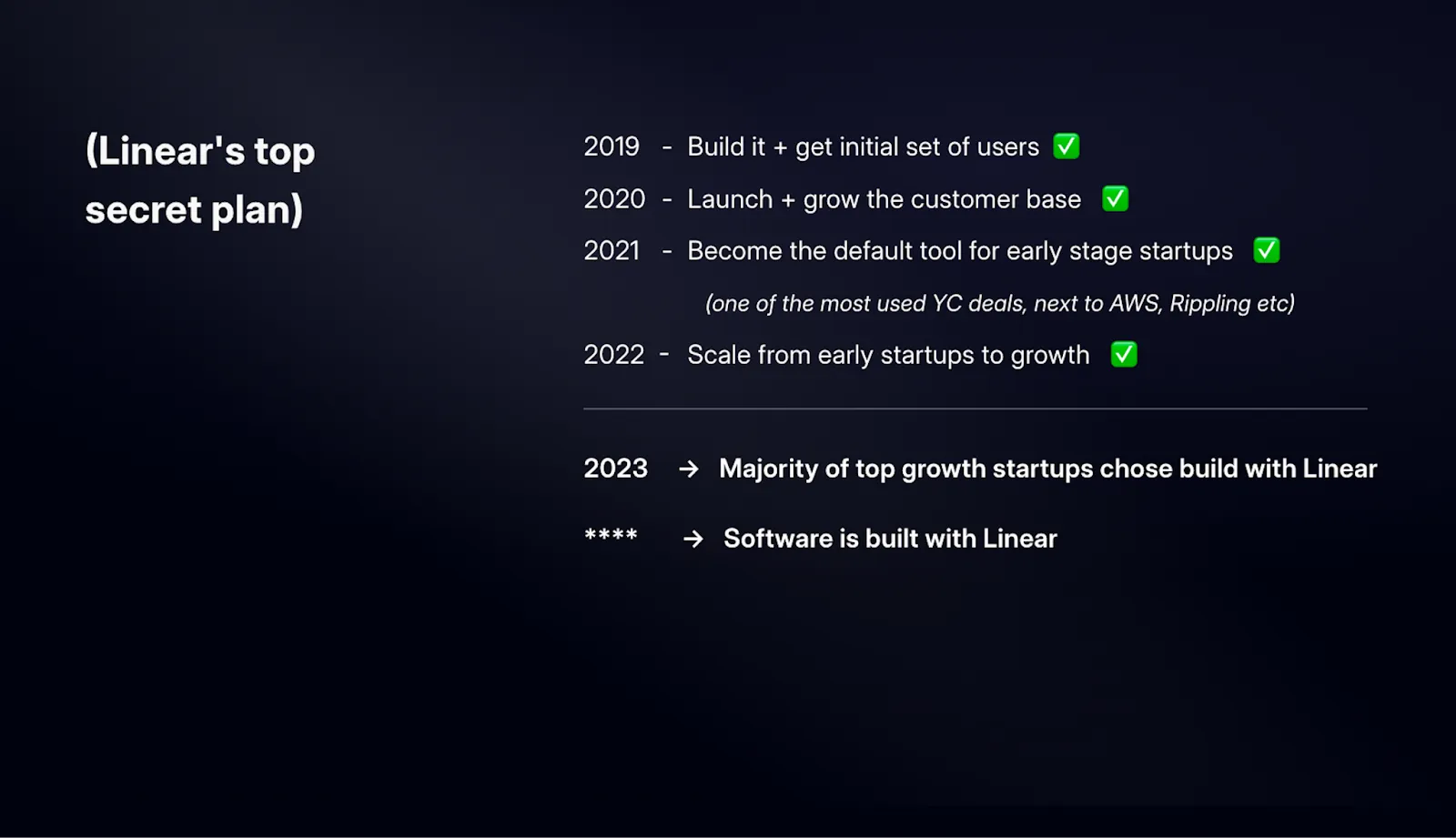
This structured progression meant clear priorities, faster iteration, and stronger retention — and ensured that each expansion built on a rock-solid foundation, rather than chasing big deals that the product wasn’t yet ready to support.
Start small to win big: focus on teams you can delight
Rather than targeting large enterprises from day one, Linear concentrated on small teams (1–20 people) who could adopt quickly and didn’t require complex sales cycles. Smaller teams often arrive without entrenched processes or heavy tooling, making them far easier to onboard.
Linear designed the product so that these teams could succeed entirely in self-serve mode: onboarding flows, documentation, and features were optimized for autonomy. This focus kept engineering priorities sharp — building only what was necessary for that specific pool, rather than chasing every feature request.
“Convincing a 20-person startup to try Linear was much easier than convincing a 300-person company.” - Adrien Griveau, founder Designer at Linear
By keeping scope tight, Linear could iterate faster, deliver visible improvements weekly, and build a loyal core of users who became the foundation for long-term growth.
The Slack Curve Playbook: level up one pool at a time
The Slack Curve principle is simple but powerful: master one user segment before moving to the next. For Linear, the sequence was:
- Nail the experience for teams of 1–20 people → Early-stage startups like Compound and Pitch (2019–2020).
- Move up to 20–100 people → Fast-growing startups like Retool and Dribbble (2021).
- Expand to 100–500 people → Growth-stage companies like Loom and Alan, with major releases like Linear Built for Scale and Linear Asks (2022–2023).
- Scale to 500+ people → Scaleups and enterprises such as Monzo, Mercury, and OpenAI (2024–2025).
And so on.
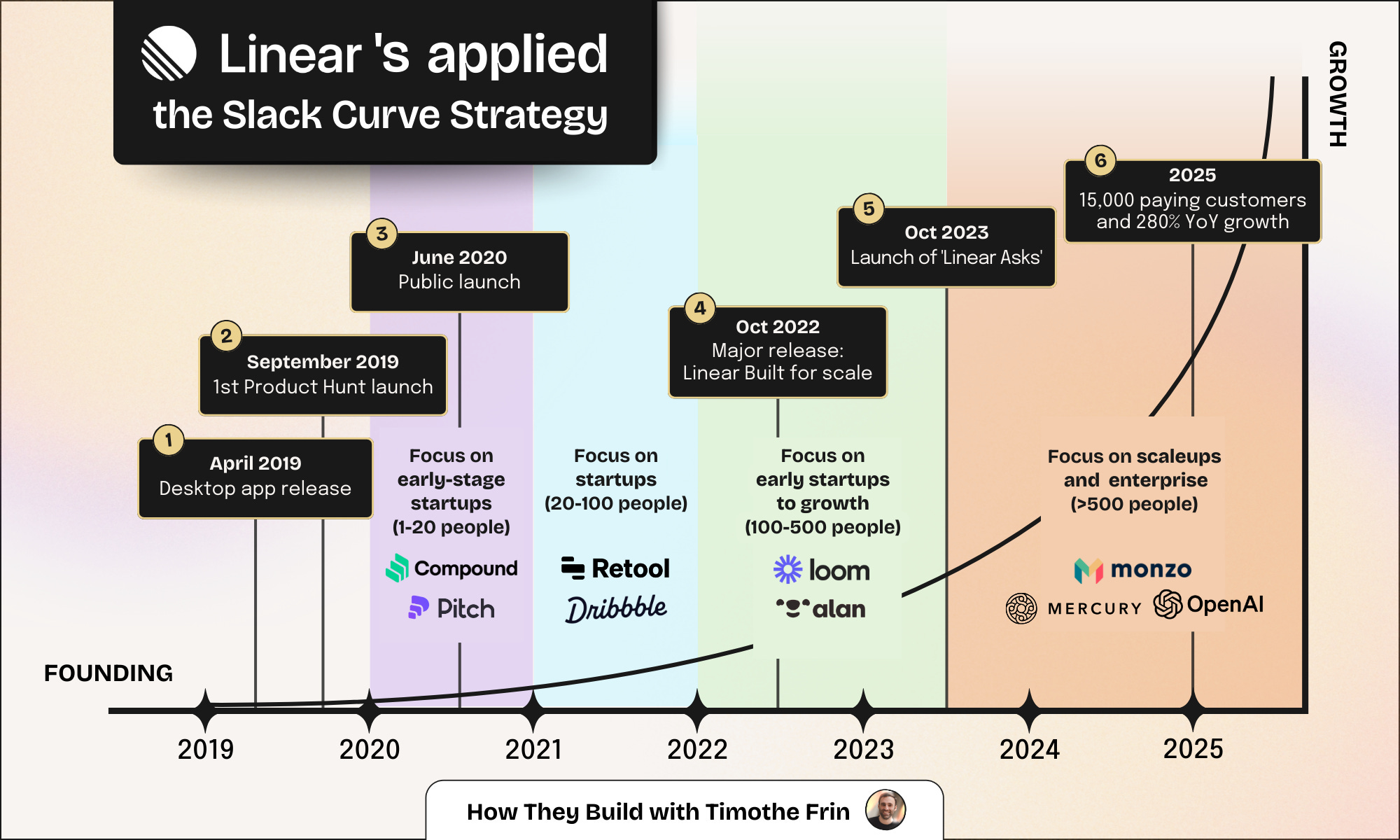
Each “level up” took around 6 months and was marked by a major release, much like an Apple keynote. These releases came with dedicated feature development, messaging, and a standalone landing page tailored to that segment.
Features not relevant to the current target segment were de-prioritized or backlogged, ensuring resources stayed focused. This discipline kept the product coherent and prevented bloat, while allowing Linear to grow in sync with its customers’ needs as they scaled.
Product-Led Trust: support that scales relationships
From the earliest days, Linear treated support as a core product function, not a cost center. Engineers and designers rotated weekly as “goalies,” reading every customer ticket, assigning issues and fixing bugs before moving on to new features.
This direct connection kept the Product team deeply aware of user pain points and allowed for fast bug resolution (often within 24 hours). Early customers were also invited into a Slack community for direct feedback loops.
For startups choosing between a huge vendor and Linear, this responsiveness was a key differentiator. A founder or engineer could see their request shipped within days, which is an impossible experience with larger incumbents.
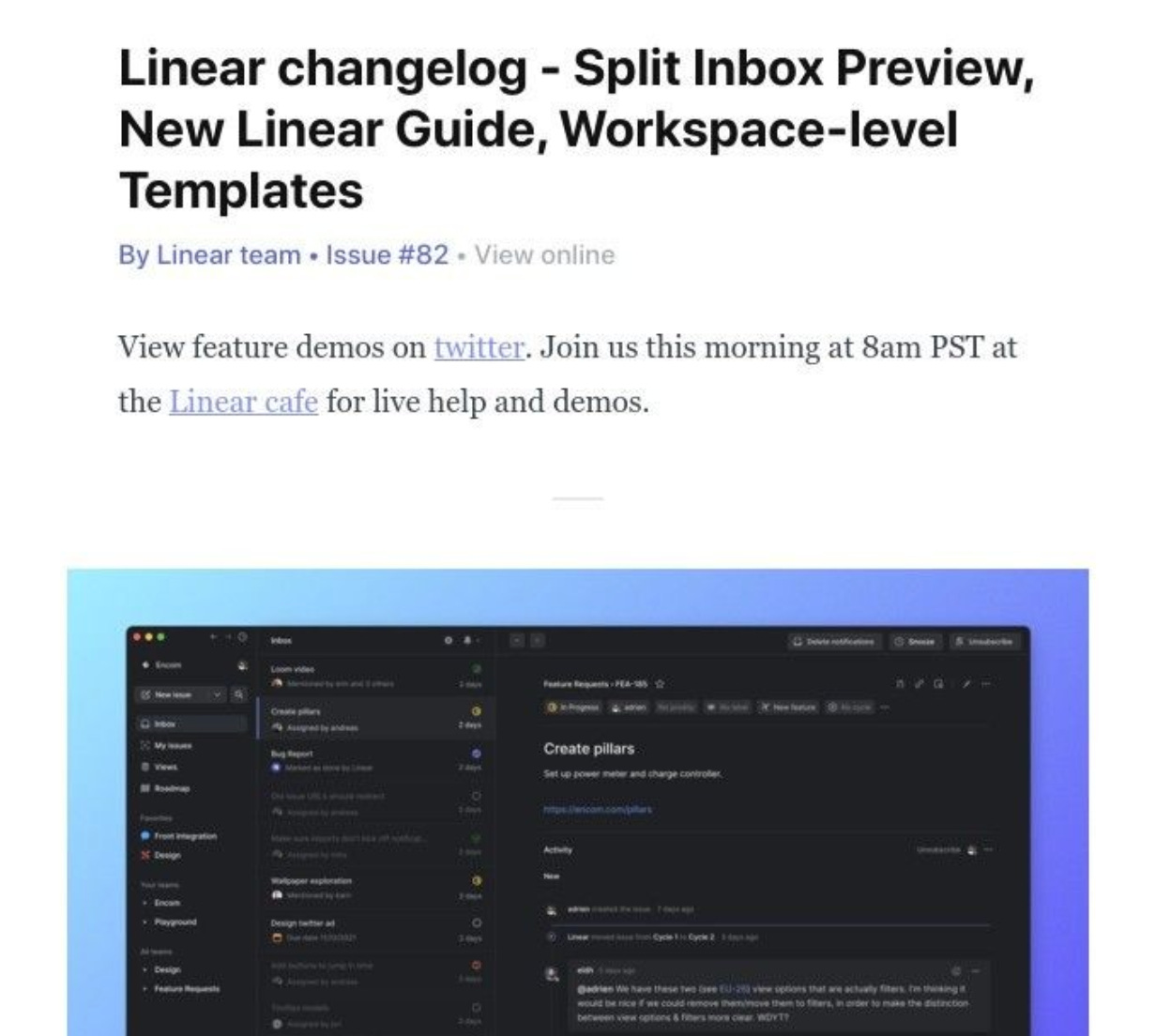
Design marketing around logos that influence your market
Not all customers have the same brand impact. Linear deliberately pursued logos that inspire mimetic adoption — companies whose use of Linear would influence others in their sector to follow.
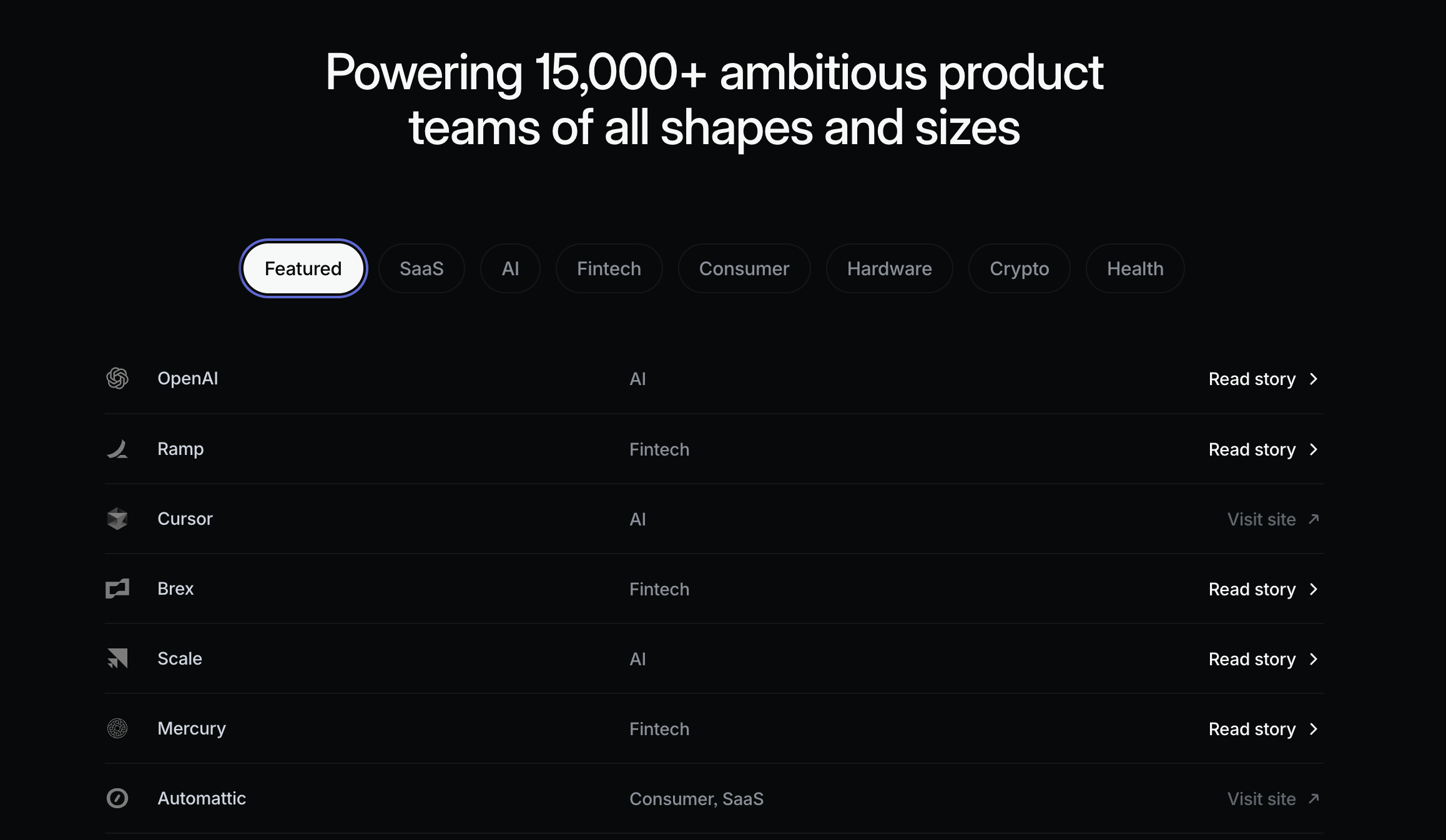
For example, landing a major fintech or crypto player would create credibility and urgency among other companies in that space. This approach also acted as social proof of stability. If a respected high-growth company trusted Linear with its core workflows, others felt confident doing the same.
Once these influential customers were onboard, Linear showcased them on dedicated release pages, turning each “win” into a marketing asset. This kept momentum high without a large ad spend.
Ride customer growth and acquisition waves
One hidden advantage of the Slack Curve: customers often grow or get acquired. Linear’s bet was that some of the early 20-person startups would become large-scale companies or be acquired by bigger ones.
When this happened, Linear’s champions inside the acquired company would advocate to keep the tool, sometimes rolling it out company-wide. This created an organic enterprise entry point without direct enterprise sales effort.
While you can’t predict acquisitions, you can improve odds by targeting top-performing, well-funded early-stage companies with strong teams — much like a venture investor’s approach.
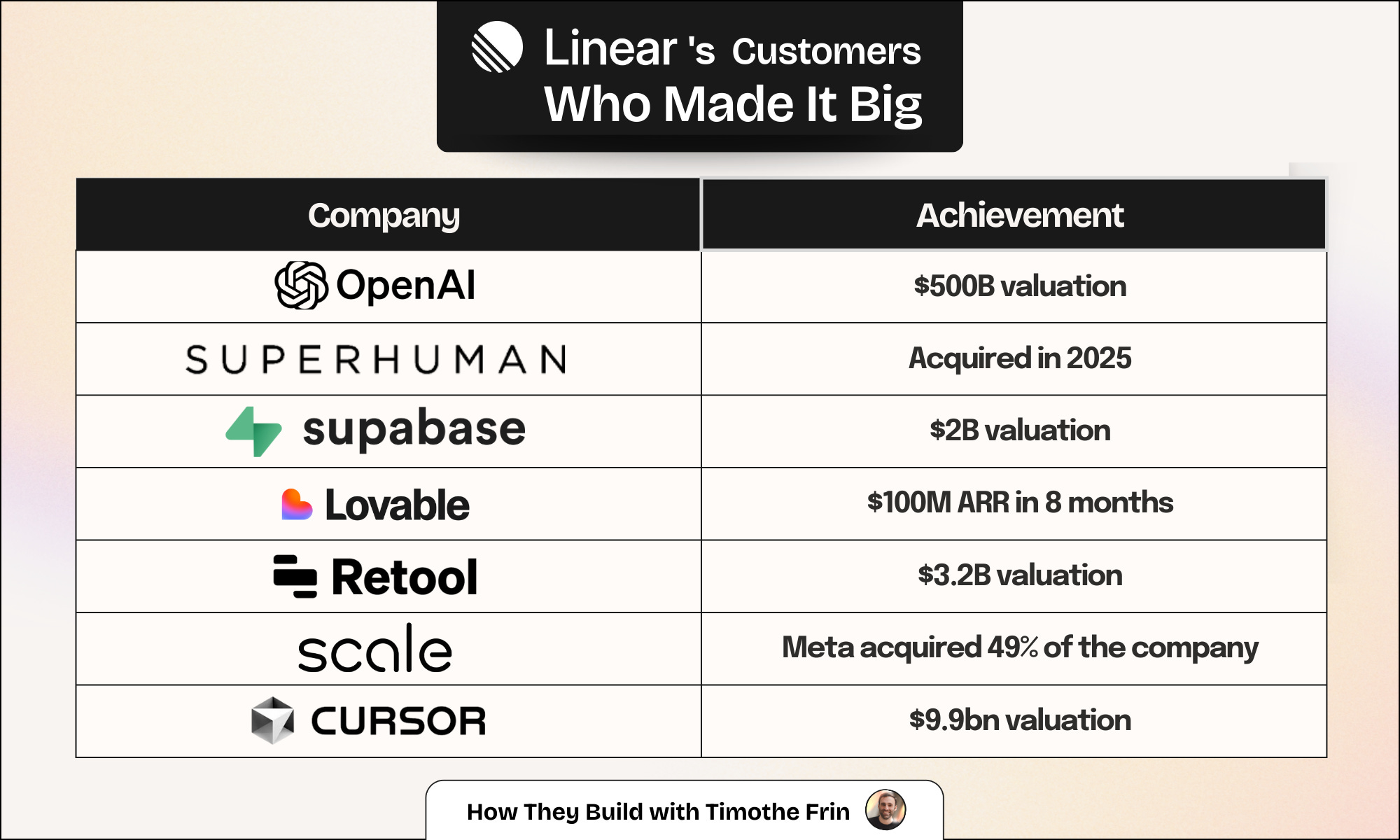
And Linear’s bet clearly paid off:
- OpenAI → $500B valuation
- Superhuman → Acquired in 2025
- Supabase → $2B valuation
- Lovable → $100M ARR in just 8 months
- Retool → $3.2B valuation
- Scale → 49% acquired by Meta
- Cursor → $9.9B valuation
Anchor the roadmap to clear six-month missions
To stay disciplined, each Slack Curve stage had a codename and mission. For six months, every product, design, and marketing decision was checked against that mission: Does this help us win this pool?
Features not fitting the mission were labeled “side quests” and backlogged unless extra time appeared. This clarity allowed fast decision-making, team-wide alignment, and measurable progress.
At the end of each mission, Linear launched a segment-specific release page, celebrated achievements internally, and moved to the next pool. The cycle repeated, building momentum with each stage.
The trap of chasing the wrong customers too early
One of the biggest potential pitfalls in applying the Slack Curve is getting distracted by customers outside your target pool.
Early on, Linear attracted attention from companies far larger than their focus segment. Sometimes hundreds of users in a single team. The temptation was obvious: keep them happy, and revenue jumps instantly. But Adrien and the team recognized the danger: those customers had needs far beyond what Linear could support at the time.
Pouring resources into building features for them would have slowed progress for the actual target segment, risked overcomplicating the product, and delayed hitting the next Slack Curve milestone. Instead, Linear onboarded these large companies into the product but made it clear that the roadmap wasn’t built for them yet. Their feedback was collected, tagged, and backlogged for when the company reached that stage.
“It’s about knowing who you want to win right now, and not letting louder voices pull you off track.” — Adrien Griveau
This discipline avoided bloated features, kept engineering velocity high, and ensured the product evolved in sync with Linear’s planned growth path.

- Start with a segment you can fully delight: optimizing the product for a small, specific pool drives retention and sets the foundation for growth.
- Advance in clear, deliberate stages: the Slack Curve Strategy works because you master one segment before unlocking the next.
- Anchor roadmap decisions to a 6-month mission: label anything outside the mission as a “side quest” to maintain focus.
- Turn support into a Product advantage: having engineers rotate through customer support builds empathy and speeds problem-solving.
- Pursue logos that inspire mimetic adoption: influential brands can act as growth multipliers in their industry.
- Leverage customer growth and acquisitions: champions in acquired companies can spread your product organically to much larger organizations.
- Maintain product simplicity as you scale: avoid adding features that serve only out-of-scope customers too early.
- Use major releases as strategic milestones: combine product, marketing, and messaging to capture attention and celebrate progress.
- Invest in changelogs and visible progress: publicizing small, frequent improvements keeps users engaged and reinforces trust.
- Design onboarding for self-serve success: the less help small teams need, the faster they become loyal advocates.
My full interview with Linear’s Founding Designer
Dive deeper into this topic with Adrien Griveau, Founding Designer of Linear, in my latest podcast episode:

Test your Product performance in 10 min
Trusted by 100+ startups and top CPOs like:


In this article
About Stellar
Stellar is a team of senior CPOs and CTOs who work hands-on inside product and engineering teams to fix what slows them down. Not advisors. Not trainers. Operators who've done the job before and know exactly where to look.
Discover StellarDive deeper
See all articles
.avif)