
Product Organization
How top CEOs shape product without becoming product managers
Real strategies, frameworks, and insights from leaders who built Europe's fastest-growing products.
23/4/2026
•
.avif)
.avif)
I analyzed 4 concrete perspectives from startup CEOs facing the same question: what is the role of the CEO when it comes to product?
Across Pictarine, Danim, Pennylane, and lemlist, the contexts are very different: consumer photo products, vertical SaaS, fintech, and outbound tools. Yet the tension is the same everywhere. The product drives the company, but the CEO cannot be everywhere at once.
Some CEOs stay deeply involved in product decisions. Others step back and focus on vision and hiring. Some organize the company so product is everywhere. Others act as a signal detector across teams.
What makes these stories interesting comes from the trade-offs, the organizational choices, and the moments when the CEO must decide how close to the product they should really be.
I broke down these 4 perspectives to extract clear, actionable lessons on the role of the CEO in product, especially in fast-growing companies.
I sat down with Guillaume Martin (CEO of Pictarine), Danyl Hassim (CEO of Danim), Arthur Waller (CEO of Pennylane), and Guillaume Moubeche (CEO of lemlist) to discuss how CEOs should engage with product without slowing down the organization.
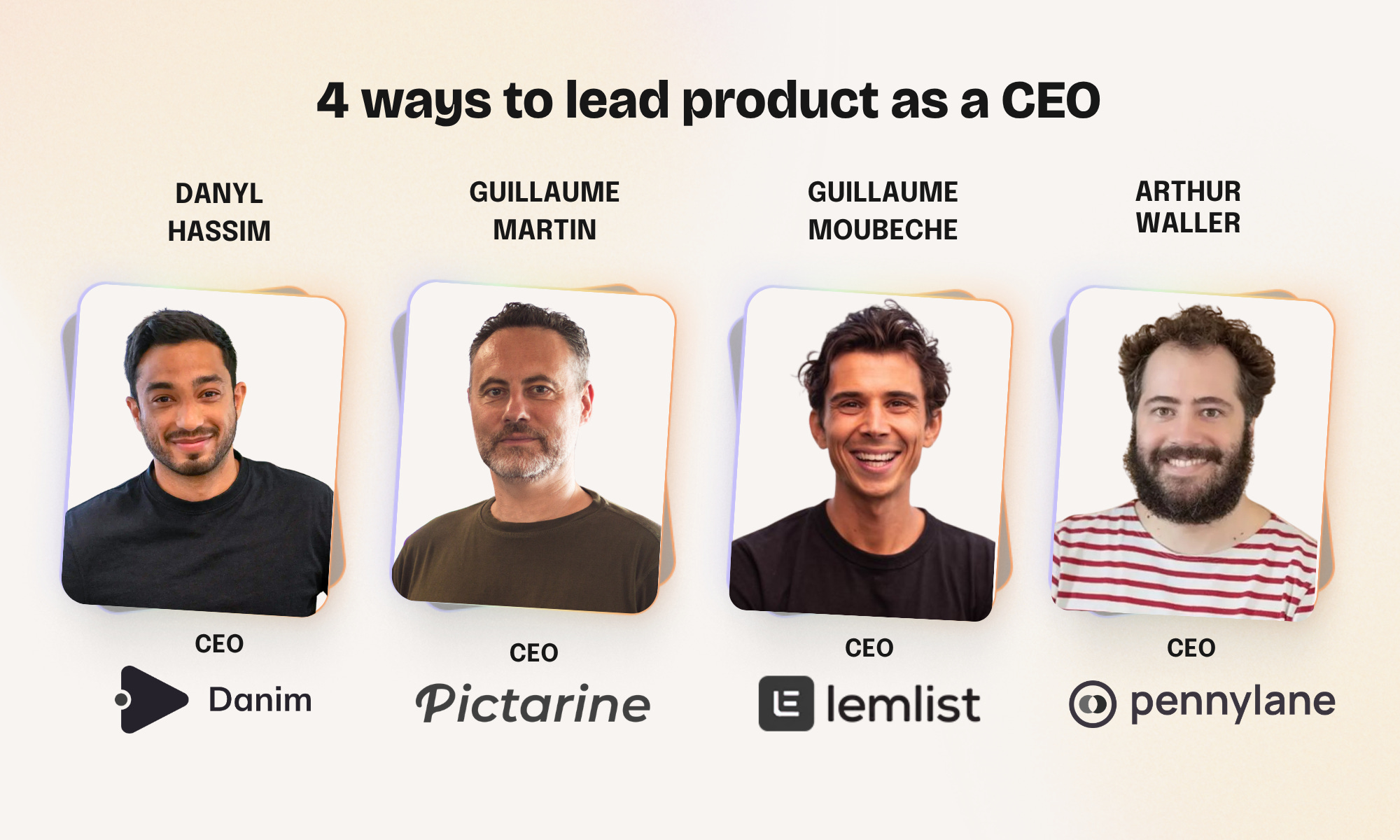
Disclaimer: The organizational choices and technical solutions shared in this newsletter aren’t meant to be copied and pasted as-is. Always keep your company’s context in mind before adopting something that works elsewhere! 😊
Set the direction and let decisions scale without you
For Arthur Waller, the CEO’s first responsibility is not to make product decisions. It is to create the conditions for others to make them well.
His role starts with clarity. The company needs a clear strategy, shared across teams, so decisions can be made without constant validation from the top.
“My role is to make sure we have a clear strategy and that everyone has what they need to make the right decisions” - Arthur Waller
This becomes critical as the company grows. Centralized decision-making does not scale. The only way forward is to decentralize decisions while keeping alignment.
That requires two things. First, a strategy that is simple enough to be understood by everyone. Second, transparency so teams can act with confidence.
In that model, the CEO is no longer the bottleneck. They become the enabler. Their job is to ensure that decisions across the company are consistent with the overall direction.
This shifts the CEO’s focus from solving problems to shaping the system in which problems are solved.
Act as a product radar, not a product owner
Even without owning execution, the CEO still needs a strong connection to reality.
Arthur Waller describes his role as a “radar”. He spends his time collecting signals across the company, from teams, customers, and data.
He multiplies touchpoints through short interactions, conversations, and feedback loops. The goal is not to go deep every time, but to detect patterns.
“I put my nose everywhere to see if something is off” - Arthur Waller
This approach allows him to identify weak signals early. When something seems off, he does not solve it himself. He escalates, questions, and triggers deeper investigation with the right people.
This is a subtle but important distinction. The CEO is not here to fix product issues directly. They are here to ensure the right problems are being addressed.
It also explains why not having a direct team can be a strength. It frees time and attention to stay connected to the entire organization instead of focusing on one function.
The CEO becomes a system observer, constantly scanning for misalignment, risks, or missed opportunities.
Own the “what” and delegate the “how”
At Pictarine, Guillaume Martin takes a different but complementary approach.
He positions the CEO as the owner of the “what”, while the organization handles the “how”.
This led to a radical decision: removing the traditional product team structure. Instead, product becomes embedded across the company.
“The roadmap is almost the company roadmap” - Guillaume Martin
In this setup, the CEO focuses on vision, priorities, and direction. Product managers and teams focus on execution and performance.
The organization is split accordingly. One side defines what to build. The other ensures it is built effectively.
This separation clarifies roles and avoids confusion. The CEO does not need to micromanage execution, but remains deeply involved in strategic product choices.
It also reflects a broader idea. In product-driven companies, product is not a department. It is the core of the business.
Stay close to the details without becoming a bottleneck
Being involved in product does not mean micromanaging.
Guillaume Martin emphasizes the importance of going into the details selectively. The goal is to understand, not to control.
He regularly talks to engineers, designers, and contributors to grasp how things work in practice. This helps him build a more grounded and realistic vision.
“It’s by going into the details that you can have a vision close to reality” - Guillaume Martin
The challenge is to find the right balance. Too far from the details, and decisions become disconnected. Too deep everywhere, and the CEO becomes a bottleneck.
The solution lies in focus. The CEO should go deep on strategic areas, where understanding creates leverage.
Trust also plays a key role. Teams must feel comfortable challenging the CEO. Without that, involvement quickly turns into implicit authority and limits healthy debate.
This creates a dynamic where the CEO contributes without dominating.
Learn the product through customers before scaling teams
At Danim, Danyl Hassim took a very hands-on approach at the beginning.
Before structuring teams, he focused on understanding the product and the market directly through sales.
He personally handled the entire sales cycle for the first customers. This gave him deep insight into user needs, objections, and value perception.
“The first 100 customers, I closed them myself” - Danyl Hassim
This phase is critical. It allows the CEO to build an intuition for the product that cannot be delegated.
Only after that did he start structuring the organization, hiring leaders, and creating management routines.
This progression matters. Early on, proximity to customers is more valuable than structure. Later, structure becomes necessary to scale.
It shows that the CEO’s role evolves over time. What matters at 0 to 1 is not the same as at 1 to 10.
Step back from execution once trust is in place
At lemlist, Guillaume Moubeche illustrates another stage of the journey.
After years of being deeply involved, he progressively stepped back from day-to-day product decisions.
He focused instead on building a strong partnership with a trusted operator, who now owns execution.
“Today, I’m not involved in product decisions day-to-day” - Guillaume Moubeche
This transition is not immediate. It requires time, trust, and the right people. It can also be uncomfortable, as the CEO lets go of control.
At one point, he found himself acting as an “inspector”, reacting after decisions were made. He deliberately changed that dynamic to avoid creating friction.
Now, his role is to shape vision, share insights, and challenge when needed, while letting others decide.
This highlights a key principle. The CEO should not stay in execution forever. At some point, stepping back becomes necessary to unlock scale.
The mistake: confusing involvement with control
One of the biggest pitfalls is misunderstanding what it means to be involved in product.
Some CEOs disengage too early and lose touch with reality. Others stay too involved and become bottlenecks.
The right approach is about balancing extremes and adjusting your level of involvement based on context.
Across these examples, a pattern emerges. The best CEOs:
- Stay close enough to understand
- Stay far enough to let teams operate
- Adjust their role as the company evolves
Confusing involvement with control leads to poor outcomes. Either decisions are disconnected from reality, or the organization slows down.
The goal is to build a system where the CEO amplifies product quality without owning every decision.

- The CEO’s primary role in product is to set direction and enable decentralized decision-making across teams.
- Acting as a “radar” helps detect weak signals without becoming directly responsible for execution.
- Separating the “what” and the “how” clarifies responsibilities and prevents product confusion at scale.
- Staying close to details selectively improves decision quality without creating bottlenecks.
- Early-stage CEOs should learn the product through direct customer interaction before structuring teams.
- Stepping back from execution requires trust and is essential to scale the organization effectively.
- Product involvement should evolve with company stage rather than follow a fixed model.
- Building a culture where teams challenge the CEO improves product outcomes and decision quality.
- The balance between proximity and delegation is the key lever for effective product leadership.
- Strong product organizations are systems where the CEO shapes direction rather than executes decisions.
Test your Product performance in 10 min
Trusted by 100+ startups and top CPOs like:


In this article
About Stellar
Stellar is a team of senior CPOs and CTOs who work hands-on inside product and engineering teams to fix what slows them down. Not advisors. Not trainers. Operators who've done the job before and know exactly where to look.
Discover StellarDive deeper
See all articles
.avif)
.avif)
.avif)