

Product Vision and Strategy
How 4 CEOs launch their product internationally
Real strategies, frameworks, and insights from leaders who built Europe's fastest-growing products.
26/3/2026
•
.png)
.avif)
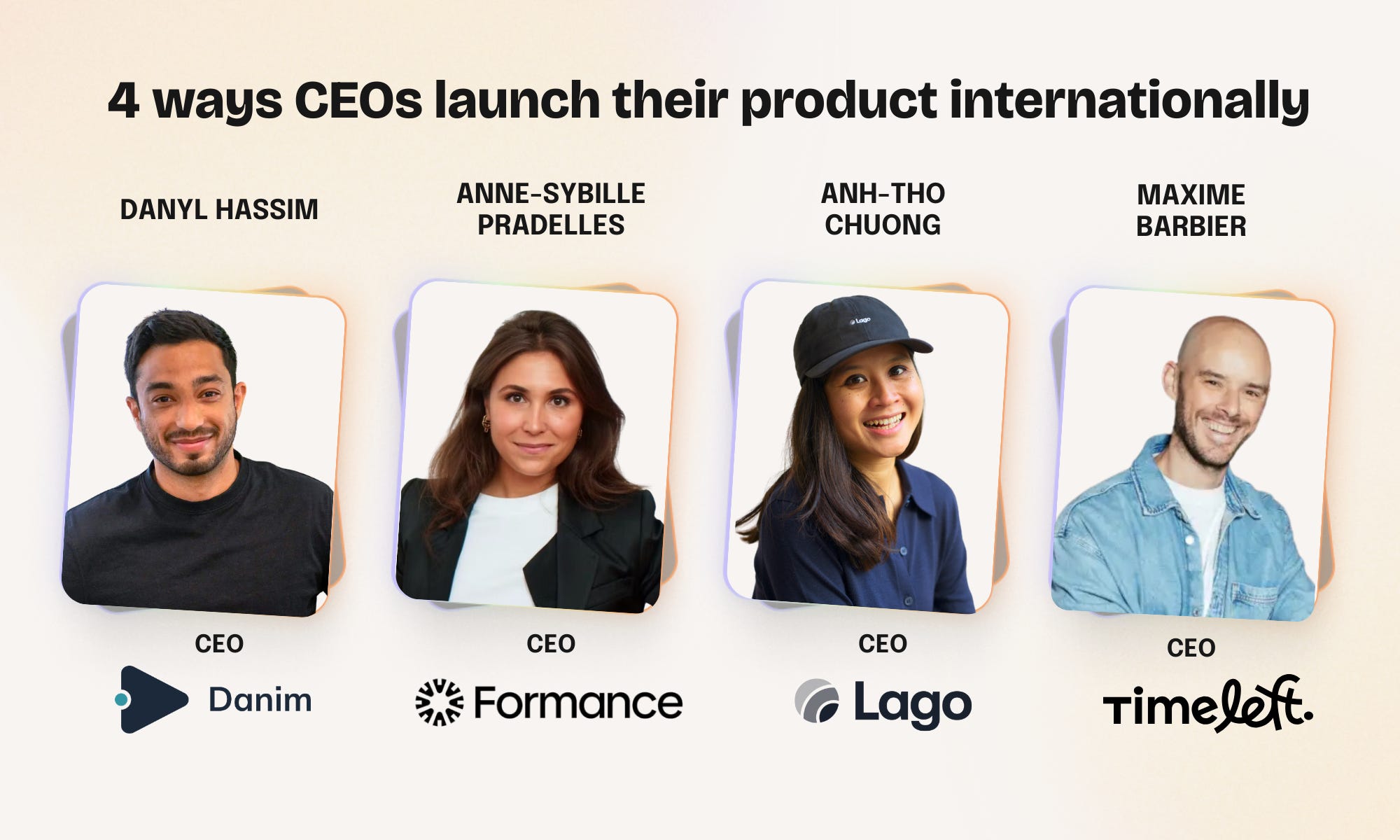
In this special episode, I pulled together insights from 4 startup CEOs who all faced the same challenge at different moments of their journey: how do you take a product that works in one market and expand it internationally?
Across Danim, Formance, Lago, and Timeleft, the contexts are very different. One company expanded across Europe through real estate networks. Another followed revenue signals to North America. A third embedded itself inside the San Francisco tech ecosystem to build a global developer product. The fourth scaled a consumer product across hundreds of cities worldwide.
Yet the underlying questions are strikingly similar. Where should you expand first? Do founders need to relocate? How should teams be structured across time zones? How much should the product change from one market to another?
Some founders expanded because partners pulled them into new countries. Others followed where revenue was already emerging. Others moved directly into global tech hubs. And some designed their product so it could scale globally from day one.
I broke down their experiences to extract concrete lessons for founders thinking about launching their product internationally.
Disclaimer: The organizational choices and technical solutions shared in this newsletter aren’t meant to be copied and pasted as-is. Always keep your company’s context in mind before adopting something that works elsewhere! 😊
Follow traction signals before designing an expansion plan
International expansion often looks strategic from the outside. In reality, it frequently begins with opportunistic traction rather than a carefully designed roadmap.
At Danim, the first international expansion came through an existing partner network. The company initially focused on France, selling its product to large real estate networks. After gaining strong adoption locally, one of these networks approached the team with a proposal: they also operated in Portugal and wanted to deploy the product there.
The opportunity simplified the expansion. The partner promoted the product internally, introduced it to local agents, and communicated about the partnership across the network before the sales team even started prospecting. That early credibility made sales conversations significantly easier.
“This strategy was dictated by the opportunity. It came to us. It wasn’t us proposing it” -Danyl Hassim
When Danim’s sales team contacted Portuguese agents, they could reference real usage from the French market and the endorsement of the same network operating locally. This drastically reduced friction in the sales cycle. Instead of selling an unknown tool, the conversation started from proven adoption.
Many startups experience a similar pattern. International expansion often begins through signals that emerge naturally: existing customers operating across borders, partner networks with international presence, or inbound demand from unexpected markets.
The lesson is simple. Early expansion rarely follows a clean strategic plan. It often follows traction.
Choose your international hub based on ecosystem density
When expanding internationally, location decisions are often shaped by ecosystem proximity rather than geography alone.
For Lago’s CEO Anh-Tho Chuong, the decision to spend time in San Francisco was driven by the density of the tech ecosystem. The city concentrates founders, engineers, investors, and early adopters building global software companies. That environment creates a unique dynamic for startups targeting developer platforms and infrastructure products.
“The level of ambition and optimism in San Francisco is unmatched” - Anh-Tho Chuong
Being physically present inside this ecosystem changes how founders operate. Conversations with other builders happen constantly. New startups emerge quickly and can become major customers within a short period of time. The network effect of the ecosystem accelerates learning and opportunity discovery.
Anh-Tho also highlights how proximity helps identify emerging companies early. Lago signed some startups when they were still small infrastructure companies generating only a few million in revenue. Some of them later grew into large players extremely quickly.
For companies building developer tools, infrastructure, or AI platforms, locating close to the ecosystem where those companies emerge can significantly influence growth opportunities. The decision is less about geography and more about proximity to the communities that will shape the next generation of customers.
Design the product so it can scale globally
Timeleft offers a very different perspective on internationalization because its product was designed to scale globally almost immediately.
The company organizes dinners between strangers in cities around the world. Within a year, it expanded to hundreds of cities.
“We opened 325 cities in one year” - Maxime Barbier
The key reason this worked lies in the nature of the product. The core experience adapts naturally to local markets because the experience itself is local by design.
A dinner in Tokyo happens with Japanese participants in a Japanese restaurant. A dinner in Bogotá happens with locals in a local restaurant. The product therefore adapts automatically to each culture without requiring heavy product changes.
“A big component of our product, the restaurant, is localized by default” - Maxime Barbier
This allowed the company to scale extremely quickly across languages and markets. Marketing campaigns could also expand efficiently. For example, campaigns created in Spanish could serve both Spain and Latin American markets.
Over time, Timeleft moved into a second phase of expansion focused on deeper localization. The team began adapting advertising visuals, marketing messaging, and customer support tone to each region.
This example highlights an important principle. Some products require heavy localization to expand internationally. Others scale globally because the core experience already adapts to local contexts.
Expand where revenue already proves demand
Formance experienced a different path toward international expansion. Instead of choosing a market first, the team followed where revenue was already emerging.
When the company analyzed its metrics around the time of its Series A, North America had already become its largest market in terms of revenue. This growth happened without actively targeting the region.
“At the time of the Series A, our number one market was already North America in terms of revenue” - Anne-Sybille Pradelles
This signal reshaped the company’s strategy. If the majority of revenue already came from the US and Canada, building a local presence became the logical next step.
Another factor reinforced this move. In the US market, engineering salaries are significantly higher than in Europe. Since Formance’s product replaces internal engineering work, the perceived value of the software increases accordingly. A product that replaces expensive internal development can command significantly higher pricing.
The company therefore chose to build the business gradually in Europe, reach product market fit, raise capital, and then expand physically to the United States once demand was clearly validated.
This sequence allowed them to expand with stronger financial security and clearer market signals.
Design your organization around time zones and hiring realities
Launching internationally forces startups to rethink how teams are structured. Time zones, hiring markets, and customer proximity all influence how organizations evolve.
Formance is building a model where go-to-market teams operate primarily from New York while product and engineering remain largely based in Europe. This allows customer facing teams to work close to the market while maintaining strong product development capacity in the original hub.
Lago adopted a slightly different structure. The company operates across Europe, the United States, and a new engineering hub in Brazil. The Brazilian team was intentionally created to support US time zones and respond quickly to American customers using the platform.
The hiring decision was also influenced by the competitive talent environment in Silicon Valley.
“In San Francisco you have to convince someone to work for you instead of OpenAI” - Anh-Tho Chuong
Large technology companies attract a huge share of engineering talent in the Bay Area. Latin America offered Lago access to strong engineering pools with less competition and better time zone coverage for US customers.
Timeleft went even further by building a fully global team distributed across multiple continents. Customer support alone required coverage across nearly all time zones because the product operates simultaneously around the world.
“When you wake up in Paris, dinners are already starting in New Zealand.” - Maxime Barbier
This operational reality forced the company to hire people across multiple regions including Asia, Europe, and the Americas.
Danim chose another structure for its sales organization. The team centralized its sales operations in Paris to maintain strong team dynamics, while hiring native speakers for each European market. This approach allows the company to combine linguistic and cultural proximity with centralized collaboration.
Across all three companies, the organization gradually adapted to support global operations.
Adapt the product before entering fundamentally different markets
Expanding internationally does not always require major product changes, as many European markets share similar operational structures that simplify expansion.
For Danim, moving from France to Spain, Portugal, and Italy required relatively limited adaptation. The real estate industry functions in comparable ways across these countries, which allowed the product to transfer relatively smoothly.
The United States represents a different situation. Real estate workflows, sales processes, and professional practices differ significantly from Europe.
“In the US everything is different. The process is different and the way properties are sold is different” - Danyl Hassim
Because of this, the company is investing time in discovery before launching there. The team is studying competitors, speaking with local agents, and working with American partners of existing networks to understand how the market operates.
At the same time, Danim is rebuilding its product architecture to make future adaptations easier. Their upcoming version introduces a more modular structure with AI embedded across multiple parts of the product, from content creation to campaign performance optimization.
This modular approach will make it easier to adapt the product to different market behaviors in the future.
The hidden operational cost of going international
One of the most underestimated aspects of international expansion is the operational complexity it introduces.
Moving to the United States, for example, involves much more than opening an office. Founders must navigate visa procedures, tax obligations, and corporate structures operating across multiple jurisdictions.
“You end up declaring things in two countries and managing accounting on both sides” - Anh-Tho Chuong
Costs also increase rapidly. Healthcare, legal services, accounting, and administrative expenses are significantly higher than in Europe. These expenses often appear manageable at first glance but accumulate quickly.
Because of this, Anne-Sybille Pradelles emphasizes the importance of financial readiness before committing to international expansion. Waiting until after a Series A provided the financial stability required to absorb these costs.
She also highlights the value of spending extended time in the target market before relocating permanently. Staying for several weeks or months allows founders to understand how customers operate, observe how the team collaborates across time zones, and build relationships locally.
International expansion therefore requires both strategic conviction and operational endurance.

- International expansion often starts through traction signals such as partners, inbound demand, or existing customers operating in multiple countries.
- Choosing the right international hub depends largely on ecosystem proximity and access to relevant networks.
- Revenue distribution can reveal expansion opportunities earlier than strategic planning.
- Companies often split product and go-to-market teams across continents to balance talent availability and customer proximity.
- Hiring hubs can emerge in unexpected regions when they provide strong talent pools and time zone coverage.
- Some markets require deeper discovery because operational workflows differ significantly from the home market.
- Modular product architecture helps companies adapt their product across multiple geographies.
- Administrative, financial, and operational complexity increases quickly when operating across multiple countries.
- Spending time in the target market before relocating permanently can significantly reduce expansion risk.
My video (in french 🇫🇷) with these 3 CEOs
Dive deeper into this topic with Danyl Hassim (CEO of Danim), Anne-Sybille Pradelles (CEO of Formance), and Anh-Tho Chuong (CEO of Lago), in my latest podcast episode.
Also available as a podcast (French for now):

Test your Product performance in 10 min
Trusted by 100+ startups and top CPOs like:


In this article
About Stellar
Stellar is a team of senior CPOs and CTOs who work hands-on inside product and engineering teams to fix what slows them down. Not advisors. Not trainers. Operators who've done the job before and know exactly where to look.
Discover StellarDive deeper
See all articles
.avif)
.avif)